

Unlock flavor-forward coffee: elevate your brew
TL;DR:
- Flavor-forward coffee emphasizes natural bean characteristics through intentional farming, processing, and roasting.
- Proper at-home brewing techniques can enhance the vibrant, nuanced flavors of quality specialty coffees.
- Pairing and tasting rituals help fully appreciate the complexity and unique profiles of flavor-forward brews.
Most people assume all coffee tastes the same: dark, bitter, and one-dimensional. That assumption disappears the moment you sip a well-crafted single-origin pour over bursting with blueberry, jasmine, or brown sugar. Flavor-forward coffee is a different category entirely, one built around showcasing what a bean naturally carries from its origin, processing, and roast. At Variatea Coffee, we believe your cup should surprise you every time. This guide breaks down what flavor-forward coffee actually means, how those flavors develop from farm to cup, and exactly how you can brew and experience them at home.
Table of Contents
- Defining flavor-forward coffee: beyond the basics
- How flavors emerge: from farm to cup
- At-home brewing: unlocking and amplifying flavor-forward notes
- Pairings and experiences: savoring coffee’s complexity
- Our take: why flavor-forward coffee deserves the spotlight
- Explore flavor-forward brews at home
- Frequently asked questions
Key Takeaways
| Point | Details |
|---|---|
| Vivid flavor over strength | Flavor-forward coffee celebrates a bean’s natural notes, not just intensity. |
| Craft matters | Processing, roast level, and brewing technique all influence which flavors emerge in your cup. |
| At-home potential | Thoughtful brewing at home unlocks impressive complexity from high-quality beans. |
| Pairings amplify experience | Tasting with the right foods can highlight new dimensions in premium coffee. |
Defining flavor-forward coffee: beyond the basics
With coffee’s reputation as bold and bitter, what makes a brew qualify as “flavor-forward”? The short answer: intentionality. Every decision, from which variety is planted to how the bean is roasted, is made to highlight specific, natural flavor characteristics rather than mask them with intensity.
Flavor-forward coffee offers vibrant, distinct tastes that highlight a bean’s origin and processing. That’s the key distinction. Mass-market coffees are typically blended and roasted dark to create consistency across massive batches. The goal is uniformity, not nuance. Flavor-forward coffee does the opposite: it preserves and amplifies what makes each bean unique.
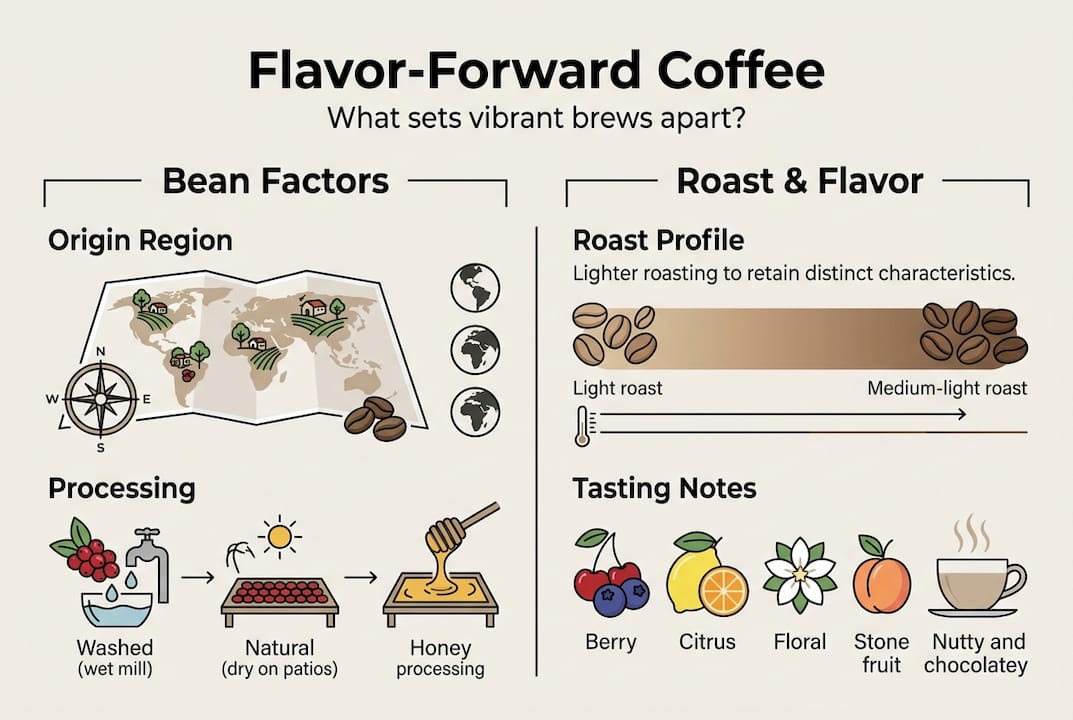
Think about the difference between a generic supermarket blend and a naturally processed Ethiopian Yirgacheffe. The blend delivers a predictable, flat bitterness. The Yirgacheffe might hit you with strawberry jam, bergamot, and a floral finish that lingers for minutes. That’s not an accident. It’s the result of careful farming, precise processing, and a roaster who knows when to stop.
The artisanal flavor profiles found in specialty coffee are built on a foundation of terroir (the environmental conditions where beans grow), genetic variety, and post-harvest technique. These factors interact to produce a flavor fingerprint that no two origins share.
“Flavor-forward coffee isn’t about making coffee taste like something else. It’s about letting the bean speak for itself, loudly and clearly.”
Here are common flavor notes you might encounter in well-crafted, flavor-forward coffees:
- Berry and stone fruit: blueberry, cherry, peach (common in Ethiopian and Kenyan naturals)
- Citrus: lemon zest, orange, grapefruit (bright in washed Central American coffees)
- Floral: jasmine, rose, lavender (found in high-altitude Yirgacheffe varieties)
- Spice: cardamom, cinnamon, clove (often present in Indonesian and Yemeni origins)
- Chocolate and nuts: dark cocoa, hazelnut, almond (typical in Brazilian and Colombian medium roasts)
- Caramel and brown sugar: toffee, molasses, vanilla (common in honey-processed beans)
Each of these notes is a direct result of the bean’s biology and the choices made along its journey.
How flavors emerge: from farm to cup
Now that you know what defines a flavor-forward brew, let’s explore how those compelling flavors actually develop.
The flavor development process begins long before roasting. It starts in the soil. Altitude, rainfall, soil mineral content, and shade coverage all shape the sugars and acids that form inside the coffee cherry. A bean grown at 2,000 meters in Ethiopia carries different chemistry than one grown at 900 meters in Brazil. That chemistry becomes the raw material for flavor.
Processing is where dramatic flavor shifts happen. Three main methods dominate:
- Washed (wet) processing: The fruit is removed before drying. Result: clean, bright, and acidic cups that showcase terroir clearly.
- Natural (dry) processing: The whole cherry dries with the fruit intact. Result: fruity, wine-like, and complex flavors with heavier body.
- Honey processing: Partial fruit is left on during drying. Result: a middle ground, sweet and smooth with moderate complexity.
Roasting then locks in or transforms those raw flavors. Very light roasts can taste grassy or sour if underdeveloped; medium roasts offer balanced, complex flavors ideal for home experimentation. Here’s a quick comparison:
| Roast level | Flavor characteristics | Best for |
|---|---|---|
| Light | Bright, fruity, acidic, floral | Single-origin pour over |
| Medium | Balanced, sweet, nutty, caramel | Versatile home brewing |
| Dark | Smoky, bitter, bold, low acidity | Espresso, milk-based drinks |
Pro Tip: Start your flavor-forward journey with a medium roast. You get enough complexity to notice distinct notes without risking the grassy or sour edges that underdeveloped light roasts sometimes carry.
Here’s the full sequence from bean to cup with flavor checkpoints:
- Variety selection: Genetic traits determine baseline flavor potential.
- Terroir and growing conditions: Altitude and climate build the sugar and acid profile.
- Harvest timing: Ripe cherries carry more developed sugars and cleaner flavors.
- Processing method: Shapes body, sweetness, and fruit intensity.
- Roasting: Develops or transforms raw flavors into what you taste.
- Grinding and brewing: Extraction pulls those flavors into your cup.
For small-batch coffee selection, every step in this chain is treated as a craft decision, not a production shortcut.
At-home brewing: unlocking and amplifying flavor-forward notes
Understanding flavor potential is just the start; now, discover how your skills at home bring those notes to life.
Precise at-home techniques can unlock surprising complexity from quality beans. The equipment you already own is likely enough. What matters more is how you use it.
Grind size is one of the biggest variables. Too fine and you over-extract, pulling bitter, harsh compounds. Too coarse and you under-extract, leaving sweetness and complexity behind. For pour over, aim for medium-fine. For French press, go coarser. For espresso, grind fine and dial in carefully.
Water temperature matters just as much. The sweet spot for most flavor-forward coffees is between 195°F and 205°F. Boiling water (212°F) scorches delicate floral and fruit notes. Water that’s too cool fails to extract the sugars and acids that make a brew interesting.
Here are critical techniques to highlight flavor-forward notes at home:
- Use filtered water: Chlorine and mineral imbalances dull flavor clarity.
- Weigh your coffee and water: A 1:15 ratio (coffee to water) is a reliable starting point.
- Bloom your grounds: Add twice the weight of water to coffee first, wait 30 seconds, then continue pouring. This releases CO2 and opens up flavor.
- Control pour speed: Slow, steady pours in pour over brewing improve even extraction.
- Keep your equipment clean: Old coffee oils coat equipment and add rancid, bitter notes to fresh brews.
Pro Tip: Fresh-roasted beans need 3 to 7 days of rest after roasting before brewing. This degassing period lets CO2 escape, which otherwise blocks proper extraction and mutes flavor.
Experimentation is your best tool. Brew the same bean two ways side by side and take notes. You’ll quickly learn what grind size, temperature, and method bring out the best in each coffee. The flavor layering tips and flavor tips for enthusiasts we’ve put together go deeper into this process if you want to push further.
Pairings and experiences: savoring coffee’s complexity
After dialing in your brew, experience matters. Pairings and rituals make flavor-forward coffee unforgettable.
Pairings like fruit or nut-based treats can accentuate coffee’s most prized flavor notes. The science behind this is straightforward: complementary flavors reinforce each other, while contrasting flavors create interesting tension that highlights both elements.
Here’s a practical comparison to guide your pairings:
| Coffee characteristic | Recommended pairing | Why it works |
|---|---|---|
| Bright, citrus-forward | Lemon tart, orange zest shortbread | Amplifies acidity and fruit notes |
| Fruity, berry-forward | Dark chocolate, cherry jam | Mirrors and deepens fruit complexity |
| Nutty, caramel notes | Almond croissant, pecan pie | Echoes sweetness and texture |
| Floral, delicate | Honey cake, light vanilla pastry | Lifts floral notes without overpowering |
| Smoky, bold | Aged cheese, dark chocolate bark | Balances intensity with richness |
For those curious about spice-infused coffee ideas, pairing a cinnamon or cardamom-forward brew with a nut-based pastry creates a layered experience that neither element achieves alone.
Mindful tasting rituals also transform how much flavor you actually perceive. Try these:
- Smell before you sip: Aroma accounts for a large portion of perceived flavor. Inhale slowly before each sip.
- Sip without swallowing immediately: Let the coffee coat your entire palate. Notice what changes as it warms.
- Identify the finish: What flavor lingers after you swallow? That’s often where the most interesting notes hide.
- Compare temperatures: Flavor-forward coffees often reveal new notes as they cool. A cup at 140°F tastes different at 110°F.
- Keep a tasting journal: Writing down what you notice trains your palate faster than any other method.
Premium coffee culture is growing fast, with specialty coffee now representing a significant and expanding share of the global coffee market. Enthusiasts who invest in tasting rituals and thoughtful pairings consistently report richer, more satisfying experiences from the same beans.
Our take: why flavor-forward coffee deserves the spotlight
With practical mastery in hand, it’s worth stepping back to reflect on why flavor-forward coffee is more than just a trend.
Here’s a contrarian view worth considering: the obsession with strength and bitterness in coffee culture has held a lot of people back. Chasing the darkest roast or the most intense espresso shot isn’t a mark of sophistication. It’s often a sign of a palate that hasn’t been challenged yet. Nuance, vibrancy, and craftsmanship are what separate a memorable cup from a functional one.
Flavor-forward coffee isn’t about snobbery. It’s about curiosity. When you start noticing that your Ethiopian natural tastes like blueberry pie or your Colombian washed has a clean, apple-like brightness, you’re not performing expertise. You’re genuinely experiencing something remarkable that took hundreds of hands and decisions to create.
The pursuit of why bold coffee matters isn’t about impressing anyone. It’s about making your daily ritual worth slowing down for. Every brew becomes a small act of appreciation for craft, origin, and skill. That’s a shift in perspective that changes how you approach your cup every single morning.
Explore flavor-forward brews at home
Ready to transform theory into taste? Variatea Coffee’s lineup is built specifically for adventurous brewers who want more from every cup.

Our Whiskey Barrel Aged coffee delivers deep, smoky bourbon and vanilla notes from authentic charred oak barrel aging, a flavor-forward experience unlike anything in a standard grocery aisle. For something sweeter and richer, the Gourmet Donut Shop coffee hits with warm, indulgent bakery notes that pair beautifully with morning rituals. And if you’re ready to explore beyond coffee entirely, our collection of artisan teas includes everything from roasted Hojicha to vibrant Hibiscus Berry, each one a flavor-forward experience in its own right.
Frequently asked questions
What makes a coffee ‘flavor-forward’ instead of just strong?
Flavor-forward coffee highlights natural origin flavors and complexity rather than simply increasing intensity or bitterness. Strength is about concentration; flavor-forward is about character.
Can I brew flavor-forward coffee with regular equipment?
Absolutely. Precise at-home techniques using a standard pour over, French press, or drip brewer can unlock real complexity as long as you start with quality beans and pay attention to grind, temperature, and ratio.
Which roast level is best for flavor-forward coffee?
Medium roasts are the most versatile starting point. They showcase balanced, complex flavors while avoiding the grassy or sour edges that underdeveloped light roasts can carry.
What foods pair well with flavor-forward coffee?
Fruit desserts, dark chocolate, nuts, and citrus-based pastries all work well. Fruit or nut-based treats in particular accentuate the most prized flavor notes in a well-crafted cup.