

Unique Tea Experiences List: 10 Must-Try Adventures
TL;DR:
- Most extraordinary tea experiences blend rare varieties with cultural depth, sensory innovation, and expert guidance to create immersive rituals. These events range from nicotine-free tea-smoking in Kyoto to community gongfu ceremonies in California, often requiring reservations and small group sizes. By choosing experiences that prioritize intention and mindfulness, enthusiasts can deepen their connection to tea beyond everyday drinking.
Most tea lovers plateau at the same three or four varieties, never realizing how far the rabbit hole goes. This unique tea experiences list was built for the drinkers who want more than a teabag and a mug. From nicotine-free tea-smoking rituals in Kyoto to expert-led gongfu ceremonies in American botanical gardens, the world of unusual tea experiences is broader, stranger, and more sensory-rich than most people expect. Here is what you need to know to find, book, and get the most from the best tea ceremonies and tasting events available right now.
Table of Contents
- Key takeaways
- What makes a tea experience genuinely unique
- 1. Chako tea-smoking ritual at Dusitthani Kyoto
- 2. Matcha wellness afternoon at Six Senses Kyoto
- 3. Gongfu tea ceremony at Taohua Tea in Sacramento
- 4. Garden Tea Tasting at Lan Su Chinese Garden, Portland
- 5. Luxury themed afternoon teas in major cities
- 6. Tea-smoking and vapor rituals as wellness practice
- 7. Small-group personalized tasting sessions with custom takeaways
- 8. Comparison of top unique tea experiences
- 9. How to choose the right experience for you
- My honest take on what makes a tea experience worth your time
- Bring the adventure home with Variateacoffee
- FAQ
Key takeaways
| Point | Details |
|---|---|
| Rarity and ritual define uniqueness | The best tea experiences combine rare varieties with intentional preparation methods and cultural context. |
| Pricing ranges widely | Sessions run from roughly $33 for individual rituals to over $150 for luxury themed events. |
| Book early, check age rules | Many premium ceremonies limit groups to 6 to 8 people and require advance reservations; some restrict under age 20. |
| Sensory innovation is growing | Tea-smoking, vapor rituals, and seasonal wellness programs are redefining how to enjoy tea. |
| Takeaways add lasting value | Premium tastings often include porcelain teaware or custom blends you can brew at home. |
What makes a tea experience genuinely unique
Not every artisan tea shop qualifies as a unique experience. The word gets overused, and that dilutes its meaning. Here is a real framework for evaluating whether something belongs on a serious unique tea experiences list.
The four markers worth looking for:
- Rarity of the tea variety. Is the tea produced in limited quantities, aged, fermented, or processed through an unusual method? Exotic tea varieties like aged pu-erh or hand-rolled oolongs are not found in grocery aisles.
- Cultural or historical depth. Does the experience connect you to a tradition, a region, or a practice with real history behind it? Japanese gongfu-style sessions and Chinese garden tastings earn their place because of that depth.
- Sensory innovation. Does the experience engage senses beyond taste? Tea vapor rituals, charcoal-warmed leaves, and aroma-forward ceremonies go well past sipping.
- Expert guidance. A trained tea master changes the experience entirely. You learn to read the tea, not just drink it.
Beyond those markers, think about the practical side: session length, group size, and how far in advance you need to book. Many tea tasting events run 45 to 75 minutes, and the most exclusive sessions cap attendance at six to eight people. That intimacy is part of what makes them worth it.
Pro Tip: Before booking, clarify whether the session is designed as formal education or social tasting. Aligning your expectations with the format dramatically improves your satisfaction, especially for workshop-style events.
1. Chako tea-smoking ritual at Dusitthani Kyoto
This is one of the most unusual tea experiences available anywhere in the world right now. The Chako ritual at Dusitthani Kyoto uses organic tea leaves from the Dusit Tea Garden, warmed over charcoal, and the vapor is inhaled directly. The experience is entirely nicotine-free and lasts approximately one hour. Optional pairings with whisky or sake are available at extra cost.
What makes Chako stand out is that it combines ancient charcoal technique with contemporary wellness and Zen-influenced mindfulness. You are not drinking tea in the traditional sense. You are engaging with it through breath and aroma, which rewires your perception of what tea can be. Priced at approximately $33 USD per session, it is one of the most accessible tea adventure activities on this list given its experiential intensity.
Note that participants under age 20 are not permitted, and advance reservation is mandatory due to the tea master’s limited availability.
2. Matcha wellness afternoon at Six Senses Kyoto
Six Senses Kyoto runs a seasonal matcha promotion that blends afternoon tea with a full wellness program. Sessions last between 45 and 75 minutes and the promotion runs through June 20, 2026, making timing critical if you want to catch it. The setting layers traditional Japanese aesthetics with modern spa sensibility, and matcha is the throughline across food, drink, and treatment.
This is a strong pick for anyone who wants the best tea ceremonies wrapped in a broader sensory context rather than a standalone tasting.
3. Gongfu tea ceremony at Taohua Tea in Sacramento
Taohua Tea runs 75-minute community-focused gongfu sessions inside a rare plant shop in Sacramento, California. The experience draws from Taiwanese tea culture and centers on mindful brewing, where each steep is intentional and the conversation between host and guests is part of the ritual itself.
The setting is intimate by design. Small groups mean you actually learn something rather than just watch. Snacks are included, and the informal atmosphere makes it one of the more approachable tea experience ideas on this list for first-timers who are curious about gongfu but do not want to fly to Asia to try it.
4. Garden Tea Tasting at Lan Su Chinese Garden, Portland
Expert Hannah Ma leads one-hour garden tastings at the Lan Su Chinese Garden in Portland, Oregon. These sessions cover traditional brewing methods, seasonal tea selection, and the cultural history behind each variety poured. Your ticket includes garden admission, and the session ends with a takeaway porcelain cup as a souvenir.
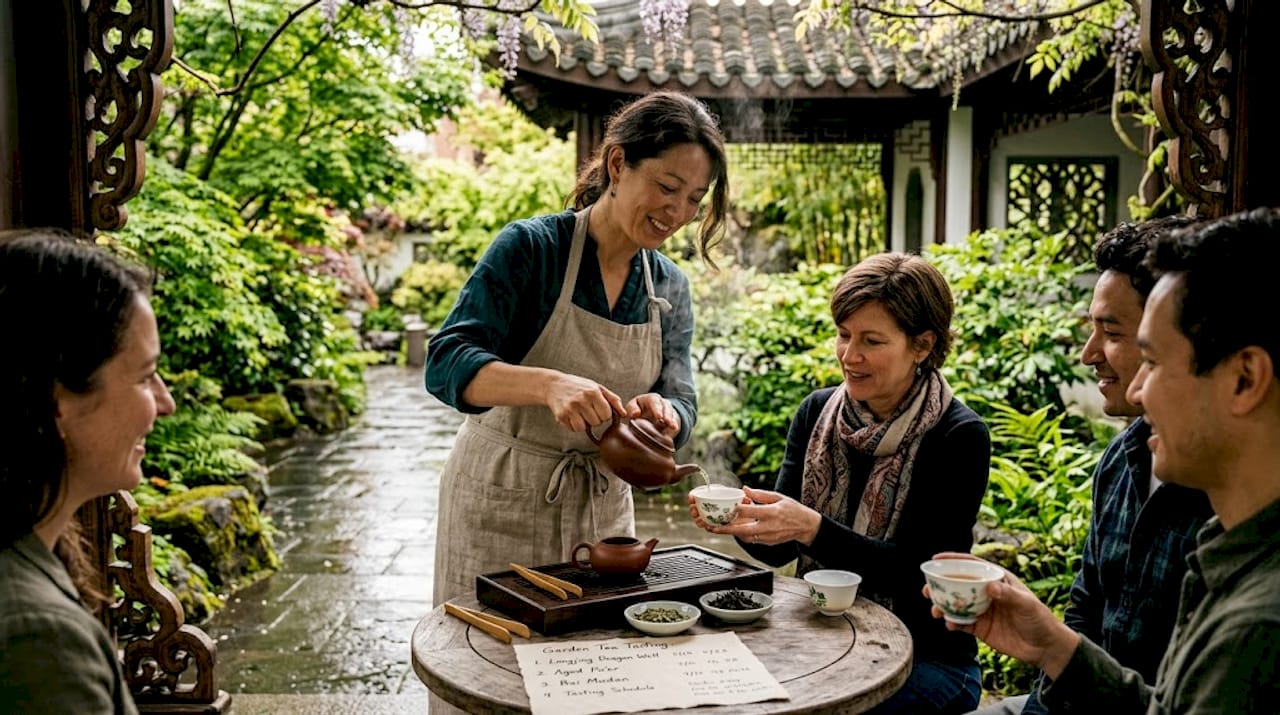
The educational dimension here is real. Hannah Ma teaches you to read water temperature, steeping time, and leaf appearance in a way that transfers directly to your home brewing practice. If you want the knowledge to stick past the experience itself, this session delivers.
5. Luxury themed afternoon teas in major cities
Themed afternoon teas in cities like New York and London occupy a different end of the spectrum. These events start around $50 and climb past $150 per person for experiences that incorporate seasonal themes, floral installations, live performance, or even caviar pairings. The tea itself is sometimes secondary to the theater, which is worth knowing before you book.
For adventurous drinkers who love spectacle alongside flavor, these events earn their spot on any unusual tea experiences list. Just go in with clear priorities: you are buying an atmosphere as much as a cup.
6. Tea-smoking and vapor rituals as wellness practice
Beyond Chako, a growing number of wellness retreats across Japan and Southeast Asia have incorporated tea vapor as a sensory treatment. Tea smoking reinterprets hojicha roasting as a nicotine-free inhalation ritual, prioritizing aroma profiles over infusion entirely. The warmth, the smell of roasted leaves, and the meditative pace of the session create a mindfulness experience that straight tea drinking rarely matches.
These rituals are still niche enough that finding one outside Japan requires research, but the category is growing. Search for wellness retreats that list “tea ritual” or “tea ceremony” as a named amenity rather than a casual offering.
7. Small-group personalized tasting sessions with custom takeaways
Some of the highest-value sessions on this unique tea experiences list are the ones nobody talks about loudly. Private, small-group tastings led by certified tea specialists. Premium sessions priced from $36 to $90 often include physical takeaways: personalized blends, handmade teaware, or tasting notes printed on quality card stock.
These experiences work best when you treat them as classes, not tastings. The takeaway is the tuition. You leave knowing how to recreate a flavor profile at home, which extends the value of that single session across dozens of future brews.
Pro Tip: Ask before booking whether the session includes a customized blend component. If it does, bring a small notebook. The flavor notes a trained specialist gives you in person are more useful than any online tasting guide.
8. Comparison of top unique tea experiences
| Experience | Price Range | Session Length | Group Size | Unique Factor | Best For |
|---|---|---|---|---|---|
| Chako Ritual, Kyoto | ~$33 USD | ~60 min | Up to 6 | Tea-vapor inhalation, charcoal warming | Wellness seekers, sensory adventurers |
| Six Senses Matcha Afternoon | Premium resort pricing | 45 to 75 min | Small groups | Seasonal wellness integration | Luxury travelers, matcha enthusiasts |
| Taohua Tea Gongfu, Sacramento | Moderate | ~75 min | 6 to 8 | Community ritual, Taiwanese culture | First-timers, cultural explorers |
| Lan Su Garden Tasting, Portland | $36 to $90 | ~60 min | Small groups | Expert-led, porcelain takeaway | Learners, home brewers |
| Themed Afternoon Tea, city hotels | $50 to $150+ | 90 to 120 min | Varies | Theatrical setting, food pairings | Occasion celebrators, flavor seekers |
9. How to choose the right experience for you
Not every tea adventure fits every drinker. Here is a practical framework to narrow your choice.
- Decide your priority: culture or sensation. Gongfu ceremonies and garden tastings prioritize cultural immersion and education. Vapor rituals and themed afternoon teas lean into sensory theater. Pick the axis that excites you more.
- Set a real budget. Factor in travel, accommodation if needed, and any optional pairings. A $33 Chako session in Kyoto looks affordable until you add a flight from New York.
- Consider group size preferences. If you want personal attention from the host, book sessions capped at six to eight people. Larger afternoon tea events are social but not instructional.
- Check seasonal availability first. Seasonal programs like Six Senses have hard end dates. Build your tea journey reviews around a calendar, not a whim.
- Book early, especially for masters. Sessions with named tea professionals fill weeks in advance. Treat booking like a restaurant reservation, not a drop-in activity.
If you want to build your palate before committing to a high-cost experience, exploring exotic tea blends at home first is a practical warm-up. You will arrive at any tasting with more vocabulary for what you are experiencing.
My honest take on what makes a tea experience worth your time
I have tasted tea in a lot of contexts, and the ones that stayed with me had almost nothing to do with price. They had everything to do with intention. The experiences on this list work because they ask something of you. You are not a passive consumer; you are a participant.
The biggest misconception I keep seeing is that “unique” means rare or expensive. It does not, necessarily. Tea tasting is deeply subjective, and what registers as memorable is personal sensory perception more than objective quality markers. I have had $33 vapor rituals that rewired my entire relationship with hojicha, and I have sat through $120 afternoon teas that felt like expensive sandwiches with a pot on the side.
What I look for now is whether the host treats the tea as the main event. A great tea master teaches you to slow down. They make you notice the color, the steam, the way the flavor shifts from first to third steep. That mindfulness dimension is what transforms a ceremony into a genuine cultural connection rather than a staged performance.
My advice: start with an experience that has a named specialist behind it. That single variable filters out the performative from the substantive faster than any review ever will.
— Jonathan
Bring the adventure home with Variateacoffee

You do not need a flight to Kyoto to experience something genuinely unusual in your cup. Variateacoffee was built for adventurous drinkers who want that same sense of discovery at home. The Whiskey Barrel Aged blend delivers a sensory experience most tea drinkers have never encountered: deep smoky notes and toasted oak character from authentic charred barrel aging, with zero alcohol. It is the kind of cup that generates the same quiet surprise as a well-run ceremony. Explore the full tea and coffee collection for more small-batch flavors, including Hojicha, Moroccan Mint, and Matcha, each roasted or blended to order and shipped fresh. If you want to sharpen your technique before diving in, check out the artisanal brewing guide to get every steep right.
FAQ
What is a unique tea experience?
A unique tea experience combines rare or unusual tea varieties with intentional ritual, expert guidance, and sensory elements beyond standard brewing. Examples include vapor rituals, gongfu ceremonies, and expert-led garden tastings.
How much do premium tea tasting events cost?
Prices range from approximately $33 USD for individual wellness rituals to over $150 per person for luxury themed afternoon tea events in major cities, depending on location and extras included.
Do I need to book tea ceremonies in advance?
Yes. Most premium sessions require advance reservations due to limited group sizes of six to eight participants and the scheduled availability of tea masters. Some also enforce a minimum age of 20.
What should I look for in a tea tasting event?
Look for sessions led by a named specialist, small group sizes, and a clear educational or sensory focus. Takeaways like porcelain teaware or custom blends are a reliable signal that the organizer values the depth of the experience.
Can I recreate unique tea experiences at home?
Absolutely. Starting with premium and unusual single-origin teas and practicing intentional brewing methods brings many of the sensory and mindfulness benefits of a formal ceremony into your own kitchen.