

Sustainable coffee: taste, impact, and value in every cup
TL;DR:
- Sustainable coffee often delivers richer, more complex flavors through ethical farming practices.
- Certifications like Fair Trade, Rainforest Alliance, and Organic ensure verified sustainability and quality.
- Choosing sustainable beans supports environmental health, community development, and gender equity worldwide.
Most coffee lovers assume that choosing “sustainable” means settling for something virtuous but bland, a compromise between conscience and craft. That assumption is wrong, and the evidence is surprisingly flavorful. The world’s most exciting, complex, and sought-after beans are increasingly coming from farms that prioritize ethical sourcing, regenerative agriculture, and direct trade relationships. Sustainable coffee isn’t a category you tolerate. It’s a category you chase, and once you understand why, your entire approach to brewing changes for the better.
Table of Contents
- What makes coffee sustainable?
- Flavor and quality: The hidden rewards of going sustainable
- The impact of sustainable coffee: Beyond the cup
- How to find and experience sustainable coffee at home
- Why sustainable coffee is revolutionizing the modern brewing ritual
- Experience sustainable flavor journeys with Variatea Coffee
- Frequently asked questions
Key Takeaways
| Point | Details |
|---|---|
| Sustainable coffee defined | Sustainable coffee relies on responsible sourcing, certifications, and ethical practices. |
| Flavor and value benefits | Choosing sustainable coffee enhances taste and supports better outcomes for farmers. |
| Broader community impact | Sustainable production uplifts communities and the environment worldwide. |
| Practical steps for consumers | You can spot, purchase, and brew sustainable coffees at home for a better ritual. |
What makes coffee sustainable?
Sustainable coffee is grown, processed, and traded in ways that protect the environment, support farming communities, and maintain long-term viability for everyone in the supply chain. It’s a broad term, and that breadth is important to understand because not every label that claims sustainability actually delivers it.
At its most meaningful, sustainable coffee involves a combination of verified practices. Key certifications like Fair Trade, Rainforest Alliance, Organic, and SCA standards, alongside practices such as agroforestry, regenerative agriculture, direct relationships, and blockchain traceability, form the real backbone of responsible sourcing. Each of these plays a distinct role.
Here’s a quick breakdown of what each approach actually delivers:
- Fair Trade certification guarantees farmers receive a minimum price for their beans, protecting them from the wild swings of global commodity markets. It also allocates a social premium that communities can direct toward schools, health clinics, or infrastructure.
- Rainforest Alliance certification focuses heavily on biodiversity and ecosystem health, ensuring that coffee farms don’t strip away native forests or deplete local watersheds.
- Certified Organic coffee is grown without synthetic pesticides or fertilizers, which benefits soil health, reduces chemical runoff into local water systems, and often produces cleaner, more nuanced flavor profiles.
- SCA (Specialty Coffee Association) standards go beyond environmental ethics and into sensory quality, scoring beans on a 100-point scale where anything above 80 qualifies as specialty grade.
- Direct trade cuts out commodity brokers, allowing roasters to pay farmers significantly above market rates in exchange for exclusive access to exceptional lots.
- Blockchain traceability is an emerging tool that creates an immutable digital record of a bean’s journey from farm to roaster, making it nearly impossible to fake origin claims.
Understanding what makes coffee premium starts with recognizing that traceability and intentionality at the farm level are what separate a remarkable cup from an ordinary one.
Pro Tip: When shopping for sustainable coffee online, look for bags that list the specific farm, region, and processing method alongside the certification seal. A bag that only says “eco-friendly” without verifiable credentials is a marketing claim, not a commitment.
The most trustworthy producers also embrace transparency about their sourcing relationships. Blockchain in particular is becoming a genuine trust-builder in specialty circles, letting you trace your bag’s origin down to the specific cooperative or washing station where your beans were processed.
Flavor and quality: The hidden rewards of going sustainable
Here’s the part that surprises most people. Sustainable sourcing doesn’t just feel good. It actively produces better, more interesting coffee. The connection between ethical farming and exceptional taste isn’t a coincidence.
Sustainable farms tend to grow coffee at higher altitudes, under shade canopy, with more biodiversity surrounding the plants. Shade-grown coffee matures more slowly than sun-grown commodity coffee. Slower maturation means the bean accumulates more sugars, acids, and aromatic compounds. The result is a denser, more complex bean with flavors that hold up beautifully across different brewing methods.
Research backs this up in concrete terms. Certified farms show meaningfully higher yields averaging 2.60 kg per tree versus 2.12 kg for uncertified farms, along with stronger prices at 568 RWF per kilogram versus 547 for conventional growers. These aren’t abstract numbers. Higher farm income means producers can afford to hand-pick only ripe cherries, slow-ferment beans for longer, and invest in better processing equipment, all of which translate directly into your cup.
“SCA award-winning sustainable producers reinvested €5 million reaching over 1 million people, while generating $1.4 million in direct income for women producers alone.” This level of reinvestment creates a cycle of quality and community that simply can’t exist in commodity-driven supply chains.
When you’re sourcing beans through innovative coffee experiences that prioritize artisanal methods, you’re often tapping into this exact ecosystem of quality and care.
The flavor profiles you can unlock through sustainable sourcing are genuinely distinctive. Here are some of the most exciting taste categories linked to certified, ethically sourced beans:
- Bright citrus and stone fruit notes from high-altitude Ethiopian natural-process beans
- Deep chocolate and molasses tones from shade-grown Guatemalan washed coffees
- Floral jasmine and bergamot hints in carefully fermented Yemeni or Yirgacheffe lots
- Butterscotch and caramel sweetness in low-intervention Colombian naturals
- Winey, fermented complexity in experimental anaerobic-process Honduran beans
These are the bold flavors in coffee that adventurous brewers spend years hunting for, and sustainable farms are where they’re most consistently found. That’s not a coincidence. It’s a byproduct of intentional growing.
| Flavor characteristic | Conventional coffee | Sustainable/specialty coffee |
|---|---|---|
| Complexity | Low to moderate | High, often layered |
| Sweetness | Often flat or bitter | Natural, nuanced |
| Acidity | Harsh or generic | Bright, clean, structured |
| Aftertaste | Short, fades quickly | Long, evolving finish |
| Traceability | Commodity blend | Single-origin or cooperative |
The data is clear. When farmers are paid fairly and have the resources to invest in their craft, the coffee they produce rewards you at the brew station.
The impact of sustainable coffee: Beyond the cup
The flavor journey is just one part of the story. Let’s look at the broader ripple effects of choosing sustainable coffee, because your purchasing decision extends far beyond your morning ritual.
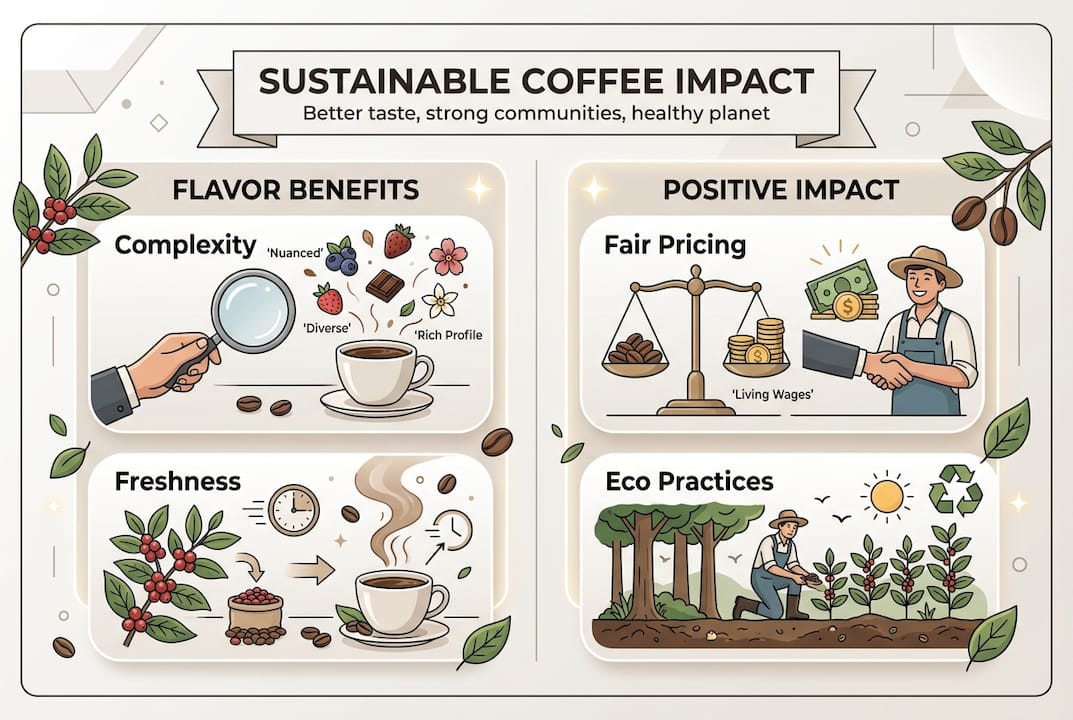
Third-party certification data shows that certified farms consistently achieve higher yields, better pricing, and stronger returns that create measurable positive outcomes for entire communities. Farmgate premiums of 15 to 30 percent above conventional prices fund tangible change, from school construction to maternal health programs to micro-loan programs for women farmers.
The environmental benefits are equally significant. Regenerative agriculture and agroforestry practices rebuild soil health rather than depleting it. Coffee grown under a canopy of native trees supports bird populations, reduces erosion, and sequesters carbon. These farms actively improve their ecosystems rather than extracting from them.
Here’s a direct comparison of conventional versus sustainable sourcing impacts:
| Impact area | Conventional sourcing | Sustainable sourcing |
|---|---|---|
| Farmer income | Volatile, commodity-tied | Stable, with premiums |
| Soil health | Often degraded over time | Rebuilt through regenerative practices |
| Biodiversity | Reduced, monoculture risk | Supported via shade canopy and agroforestry |
| Community investment | Minimal | Directed through social premiums |
| Carbon footprint | Higher, intensive inputs | Lower, with active sequestration |
| Gender equity | Often overlooked | Prioritized through specific programs |
As a home brewer, your purchase travels backwards through this entire chain. Here’s how it plays out step by step:
- You buy a certified sustainable coffee from a specialty roaster or premium brand.
- The roaster pays a farmgate premium of 15 to 30 percent above commodity price.
- The cooperative receiving those funds allocates a portion to their community social fund.
- Farmers invest in better processing equipment, which improves bean quality.
- The social fund supports a local education or healthcare initiative.
- Women producers receive direct income boosts and leadership opportunities.
- The farm’s environmental practices improve local biodiversity and water quality.
- Better farming conditions and incentives attract skilled workers, raising quality further.
Your morning ritual powers that entire sequence. That’s not a small thing.
Pro Tip: If you want to maximize your positive impact as a home brewer, prioritize brands that publish their sourcing relationships publicly. Look for named farms, cooperatives, or specific regions on the packaging. Transparency is the clearest signal that a brand’s sustainability commitment is real rather than performative.
Exploring unique coffee rituals that center on intentional, sustainable beans transforms your daily brew from a habit into an act of connection with a global community of growers.
How to find and experience sustainable coffee at home
Ready to elevate your habits? Here’s how to put these insights into action at home, because knowing the theory is one thing, and building a sourcing practice that consistently delivers is another.
The first skill to develop is reading coffee labels with real scrutiny. Legitimate sustainable coffee typically features specific information rather than vague claims. Look for these elements on any bag you’re considering:
- Verify the certification seal. Recognize logos from Fair Trade USA, Rainforest Alliance, USDA Organic, and SCA-affiliated roasters. These are audited third-party programs, not self-declarations.
- Identify the origin specificity. “Latin America blend” is a red flag. “Huila, Colombia, Finca La Esperanza” is a green flag. Named farms or cooperatives signal genuine traceability.
- Check the harvest or roast date. Sustainable specialty beans are seasonal. A roast date within the last 90 days means you’re getting something fresh rather than warehouse-aged commodity stock.
- Look for processing method disclosure. Washed, natural, honey processed — these terms indicate that the producer cares about the steps between cherry and roaster, which is exactly where flavor is developed or lost.
- Research the roaster’s sourcing page. Any serious sustainable roaster will have a dedicated sourcing or impact page on their website. If they don’t, that absence tells you something.
Certifications like Fair Trade, Rainforest Alliance, Organic, and SCA standards alongside direct relationships and traceability tools are your best verification tools when shopping online, where you can’t taste before you buy.
Once you have a great bag in hand, your brewing method shapes how much of that flavor you actually experience. Sustainable beans with natural process complexity tend to shine brightest through a pour-over or AeroPress, where you can control extraction precisely. Washed high-altitude beans often reveal their citrus clarity in a standard drip setup or a cold brew concentrate.
Experimenting with water temperature also matters more with specialty sustainable beans than with commodity coffee. Try brewing Ethiopian natural-process beans at 195°F rather than the standard 205°F. You’ll often find the fruit notes open up in a way that higher temperatures suppress.
Pro Tip: To truly highlight what a sustainable single-origin bean is doing, try a simple side-by-side comparison. Brew the same sustainable bean using both a pour-over and a French press. The pour-over will isolate delicate floral and citrus notes while the French press will amplify body and chocolate depth. This technique, similar to coffee cupping at home, trains your palate quickly and makes sourcing decisions much more informed going forward.
The best place to start your sustainable sourcing journey is with a specialty e-commerce brand that does the verification work for you, curating only beans that meet rigorous flavor and ethical standards. That way, your exploration begins with a strong foundation rather than a guessing game.
Why sustainable coffee is revolutionizing the modern brewing ritual
Here’s a perspective worth sitting with. Most people treat “sustainable” as a modifier, something that softens the main product, makes it feel responsible but slightly less exciting than its conventional counterpart. That framing is exactly backwards.
The most innovative, boundary-pushing producers in specialty coffee today are using sustainability as a creative framework. Regenerative farming encourages crop diversity, which introduces new soil microbiomes that affect bean flavor at a chemical level. Direct trade relationships give roasters early access to experimental lots, like anaerobic fermentation trials or rare varietals, that never reach commodity markets. These are innovations funded and enabled by sustainable premiums.
At Variatea Coffee, we’ve watched this play out in our own sourcing philosophy. The idea that premium e-commerce coffee can bridge artisanal craft with ethical supply chains isn’t aspirational. It’s already happening. Home brewers who prioritize sustainability aren’t making a compromise. They’re gaining access to a tier of flavor and story that conventional coffee drinkers never reach.
The adventurous brewer who demands bold, complex, uncommon flavor is the same person whose purchasing behavior most powerfully supports the farmers who make those flavors possible. That alignment between your personal pleasure and global impact is not accidental. It’s the design of the sustainable coffee movement at its best.
Experience sustainable flavor journeys with Variatea Coffee
If you’re inspired to explore what ethical sourcing tastes like in practice, we curate exactly that kind of experience at Variatea Coffee.

Our whiskey barrel-aged coffee brings together the rich depth of charred oak and vanilla with a commitment to artisanal craftsmanship that goes far beyond standard roasting. If you’re looking for an energy-forward option with exceptional complexity, our Max Caf Blend delivers bold flavor and serious caffeine in equal measure. And for those days when you want something beyond coffee, our curated artisan teas include hojicha, ceremonial matcha, and hibiscus berry blends that bring the same adventurous sourcing philosophy to every steep. Every product we offer reflects our belief that premium flavor and ethical practice belong together.
Frequently asked questions
What are the most important sustainable coffee certifications?
Fair Trade, Rainforest Alliance, Organic, and SCA standards are the most recognized and rigorously audited certifications to look for when buying sustainable coffee. Each one targets a different aspect of ethics, quality, and environmental responsibility.
Does sustainable coffee taste better?
Many sustainably sourced coffees deliver more complex, distinctive flavor profiles because careful growing conditions, slower maturation, and meticulous processing create a richer sensory result than commodity methods allow.
How can coffee support women’s empowerment?
Sustainable programs have generated $1.4 million in direct income for women producers, and many certified cooperatives specifically direct social premiums toward gender equity initiatives including leadership training and financial independence programs.
What’s the easiest way to start brewing sustainable coffee at home?
Look for certified beans with named farm origins from a specialty online shop, then use a pour-over or French press to highlight the unique flavors that intentional, ethical farming produces.