

How to Store Gourmet Coffee Blends for Peak Freshness
TL;DR:
- Proper storage conditions—cool, dark, and dry—are essential to maintaining the freshness and flavor of gourmet coffee blends. Using vacuum-sealed, opaque containers and grinding only before brewing significantly extend shelf life and preserve aroma. Coffee should be consumed within 2 weeks of grinding and 3 to 4 months of roasting for optimal taste.
You spent real money on a gourmet blend with tasting notes that read like a dessert menu. Then you left the bag on the counter, next to the stove, and two weeks later it tasted like cardboard. Knowing how to store gourmet coffee blends is the difference between experiencing every layer a roaster worked hard to create and drinking a flat, lifeless cup. This guide covers ideal storage conditions, container selection, whole bean versus ground coffee rules, and advanced techniques so your blends stay as vivid on week four as they were on day one.
Table of Contents
- Key takeaways
- How to store gourmet coffee blends: ideal conditions
- Choosing the right storage containers
- Whole beans versus ground coffee storage
- Advanced storage methods: freezing and vacuum sealing
- Daily habits that protect your coffee
- My take on what actually matters with storage
- Protect your blend from the moment it arrives
- FAQ
Key takeaways
| Point | Details |
|---|---|
| Environment is the first priority | Keep coffee at 60–70°F, below 50% humidity, and away from light to slow staling. |
| Container choice matters more than location | Vacuum-sealed containers with silicone gaskets extend freshness up to 3–6 times longer than standard jars. |
| Grind just before brewing | Whole beans stay fresh for months; ground coffee goes stale within 5–7 days even when sealed. |
| Freezing requires strict rules | Freezing works only when coffee is portioned, airtight, and never repeatedly thawed. |
| Use roast date as your guide | Coffee tastes best 7–14 days after roasting and declines sharply after three months. |
How to store gourmet coffee blends: ideal conditions
Before you think about containers, you need to think about the environment your coffee lives in. Heat, humidity, and light are the three accelerants of coffee staling, and they all degrade aroma and flavor complexity faster than most people realize.
Here are the conditions you should be aiming for:
- Temperature: Keep your coffee between 60°F and 70°F. Above that range, the oils in the beans start breaking down. Your kitchen counter near the stove or next to the toaster is almost certainly above that threshold when the appliances are running.
- Humidity: Moisture is coffee’s quietest enemy. Aim for relative humidity below 50%. A humid cabinet near the sink or above the dishwasher exposes your beans to steam and ambient moisture every single day.
- Light: UV exposure oxidizes coffee oils rapidly. Clear glass jars on a sunny windowsill look charming, but they are actively destroying your investment.
- Air: Every second your bag or container is open, oxygen is reacting with the volatile compounds that make your blend taste the way it does.
The solution is simpler than it sounds. Find the coolest, darkest, driest spot in your kitchen. A cabinet away from appliances that generate heat is usually the best option. A pantry or dedicated coffee shelf in a low-humidity room works even better.
Pro Tip: If your kitchen runs warm, a small countertop cabinet in a cooler part of your home, such as a hallway or dining room sideboard, will do more for your coffee’s freshness than any premium container placed right next to the oven.
Choosing the right storage containers
This is where most people make the biggest mistake. They buy something labeled “airtight” and assume the problem is solved. It is not. Many common airtight jars are only air-resistant, meaning they slow oxygen exchange but do not stop it.
True airtight containers use silicone or rubber gaskets to form a physical seal, and the best ones add a vacuum pump mechanism that actively removes oxygen from inside the container. Vacuum-sealed containers can extract up to 95% of oxygen, compared to the 20–40% reduction you get from a standard screw-top jar. That difference translates directly to how long your coffee stays flavorful.
Here is a practical comparison of your main container options:
| Container type | Oxygen protection | Light protection | Best use case |
|---|---|---|---|
| Vacuum-sealed with gasket | Excellent (up to 95% oxygen removed) | Good if opaque | Long-term whole bean storage |
| Opaque ceramic with rubber seal | Very good | Excellent | Daily-use container, countertop storage |
| Stainless steel canister | Good | Excellent | Durable daily storage, no light exposure |
| Tinted glass with airtight lid | Moderate | Moderate | Short-term use in dark spaces |
| Clear decorative glass jar | Poor | None | Aesthetics only. Not for fresh coffee. |
Size is another factor most people overlook. A container that is three times larger than your coffee supply leaves a lot of oxygen above the beans. Match your container size to your typical one-to-two-week supply. If you buy in bulk, vacuum seal portions separately rather than dumping everything into one large canister.
Pro Tip: Professional roasters use nitrogen flushing post-roast to displace oxygen entirely. At home, a pump-action vacuum container mimics that effect at a fraction of the cost and is one of the best single investments a coffee enthusiast can make.
Whole beans versus ground coffee storage
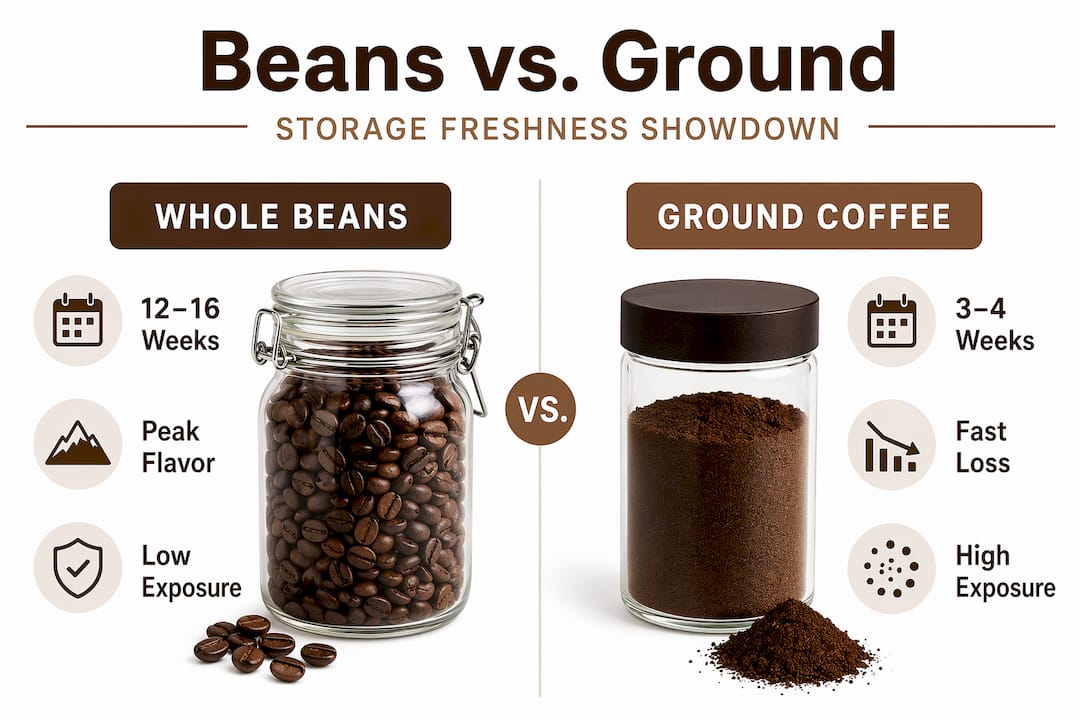
The form your coffee is in when you store it makes a dramatic difference. Whole beans maintain peak flavor for 12–16 weeks in vacuum-sealed, opaque containers. Ground coffee, under the same conditions, goes stale within 5–7 days.
The reason is surface area. When you grind coffee, you shatter each bean into hundreds of small particles, exposing exponentially more surface area to oxygen. The volatile aromatic compounds that give your gourmet blend its distinct character escape rapidly. What took a roaster weeks of craft to develop disappears in less than a week once ground.
Here are the storage rules that apply specifically to each form:
For whole beans:
- Store in a vacuum-sealed, opaque container at room temperature in a cool, dark location.
- Keep away from moisture, heat sources, and direct light.
- Whole beans stored properly can last 3–4 months without significant flavor loss.
- Buy in quantities you can realistically use within that window.
For ground coffee:
- If you pre-grind, portion into single-use servings and seal tightly between uses.
- Store in the smallest container that holds your supply to minimize headspace.
- Plan to use ground coffee within two weeks at most, though freshness peaks in the first few days.
- Consider investing in a quality burr grinder so you can grind fresh before every brew session. The flavor complexity you protect with a fresh grind is immediately noticeable.
The simple takeaway: grinding just before brewing is the single highest-return habit you can build for better coffee, regardless of how sophisticated your storage setup is.
Advanced storage methods: freezing and vacuum sealing
Freezing coffee is the topic that splits coffee enthusiasts most sharply. Some swear by it. Others insist it ruins the beans entirely. The truth is that both sides are right, depending on how you do it.
Here is what the evidence and experience actually support:
-
Freeze only in airtight, vacuum-sealed portions. Freezing preserves freshness when beans are sealed and stored without air. Use vacuum-sealed bags or containers, divided into single-week portions, before the beans ever touch the freezer.
-
Never refreeze thawed coffee. Each freeze-thaw cycle pulls moisture into the bean structure through condensation. Repeated thawing is the main reason frozen coffee disappoints. Take out one portion, let it come to room temperature sealed, then open it. Do not put it back.
-
Use the freezer for long-term storage only. If you receive a large order or want to stockpile a limited release, the freezer can extend shelf life significantly. For coffee you plan to drink within two to three weeks, room temperature storage in a vacuum-sealed container is the better approach.
-
Beware of freezer odors. Coffee easily absorbs ambient odors, and a freezer shared with leftovers, fish, or anything pungent will contaminate your beans permanently. Double-sealing in a Mylar bag inside a vacuum container significantly reduces this risk for long-term freezer storage.
-
Mylar bags with oxygen absorbers are the gold standard for storage beyond two months. They block light, moisture, and oxygen simultaneously and are the same method used by long-term food storage specialists.
-
Avoid the refrigerator entirely. Unlike the freezer, a refrigerator does not get cold enough to slow oxidation meaningfully, but it is cold enough to cause repeated condensation cycles every time you open the door. The humidity and odor exposure in most refrigerators does more harm than good.
Daily habits that protect your coffee
Good storage is not a one-time setup. It is a routine. Small, consistent habits preserve your coffee aroma and flavor far better than any single premium container.
- Check your roast date every time you buy. Coffee tastes best 7–14 days after roasting, once the initial CO2 degassing slows down. Buy from roasters who print this date on the bag, and plan your consumption around it.
- Portion your supply when you open a new bag. Divide a large bag into two or three smaller sealed portions immediately. Only open one at a time. This limits how often the rest of the supply is exposed to air.
- Close your container firmly after every single use. It sounds obvious, but loose lids and partially folded bags are the most common cause of unexpectedly stale coffee.
- Keep coffee away from strong-smelling foods. Even in a sealed container, storing your coffee next to a garlic basket or an open spice rack raises the ambient odor level in the cabinet.
- Audit your storage setup every few weeks. Check that gaskets are still sealing, containers are not cracked, and your storage location has not gotten warmer or more humid with a change in season.
Pro Tip: Professional baristas use portion control to minimize oxygen exposure from repeated container openings. Dividing your weekly supply into two or three portions and only opening one at a time is one of the most effective and underused habits in home brewing.
My take on what actually matters with storage
I’ve been through enough storage failures to have opinions about what conventional advice gets wrong. The most common one: people focus obsessively on brand-name containers while ignoring the environment those containers sit in. I’ve watched people keep a $60 vacuum canister on top of their refrigerator, where the compressor pumps out heat all day, and then wonder why their specialty coffee tastes dull.
The container matters. But a great container in a poor environment still loses. Get the environment right first, then upgrade your container.
I’ve also found that the fridge advice people still repeat, storing open coffee bags in the refrigerator for freshness, backfires almost every time. The temperature is not stable enough to slow oxidation, and the odor absorption is real. I once ruined a spectacular whiskey barrel-aged blend by storing it next to some leftover stew. The coffee tasted like it. Not metaphorically. Literally.
My other contrarian take: freshness windows are shorter than most people want to believe. The roast date benchmark of 7–10 days post-roast for peak flavor is not marketing. It is accurate. After three months, even well-stored beans lose meaningful complexity. Buy smaller quantities more frequently and you will drink better coffee every single time.
— Jonathan
Protect your blend from the moment it arrives

At Variateacoffee, every blend ships with freshness built into the process. The Whiskey Barrel-Aged Coffee arrives sealed to lock in the deep smoky vanilla and bourbon notes that come from authentic charred oak barrel aging. Those flavors are the result of a precise, time-intensive craft, and proper storage at home is what lets them fully express themselves in your cup.
To get the most from every order, explore the full Variateacoffee collections and find your next small-batch blend. Each product is roasted to order and packed with the kind of tasting notes that are worth protecting with everything this guide has covered.
{% embed
FAQ
What is the ideal temperature for storing coffee?
The optimal storage temperature for gourmet coffee is between 60°F and 70°F. Temperatures above this range accelerate the breakdown of coffee oils and reduce aroma complexity.
How long do whole coffee beans stay fresh?
Whole beans stored in vacuum-sealed, opaque containers maintain peak flavor for 12–16 weeks, compared to just 3–4 weeks in standard containers.
Can you store gourmet coffee in the freezer?
Yes, but only if the coffee is portioned into single-use amounts, vacuum-sealed, and never repeatedly thawed. Condensation and odor contamination from repeated thawing will degrade the flavor quickly.
Should coffee be stored in the refrigerator?
No. Refrigerators do not get cold enough to meaningfully slow oxidation, and coffee absorbs ambient odors from other foods, permanently altering the flavor profile of your blend.
How soon after roasting should you drink your coffee?
Specialty coffee experts recommend brewing between 7–14 days post-roast, after the initial CO2 degassing period, to experience the fullest flavor complexity. Beyond three months, even properly stored beans lose significant depth.