

How to blend spice infused coffee for bold flavor
Your morning cup doesn’t have to taste ordinary. If you’re tired of the same flat profile day after day, blending spices directly into your coffee grounds before brewing unlocks layers of warmth, complexity, and artisanal character you won’t find in pre-flavored pods. This guide walks you through selecting the right spices, mixing them with your favorite beans, and brewing techniques that extract maximum flavor without grit or bitterness. Whether you’re drawn to cinnamon’s sweet heat or cardamom’s floral punch, you’ll learn how to craft a signature spiced coffee that rivals any cafe creation.
Table of Contents
- Key takeaways
- What you need: spices, coffee, and tools
- Step-by-step guide to blending and brewing spice infused coffee
- Tips for different brewing methods and troubleshooting common mistakes
- Creative spice blend recipes and pairing ideas
- Explore premium coffee blends to enhance your spice infused experience
- Frequently asked questions
Key Takeaways
| Point | Details |
|---|---|
| Spice infusion method | Mixing spices with coffee grounds before brewing extracts flavors evenly and minimizes grit. |
| Popular spice pairings | Cinnamon, cardamom, and ginger provide balanced warmth and floral or citrus notes when paired with the right roast. |
| Grind fresh before brewing | Freshly ground spices release more volatile oils and aroma, so grind just before brewing for maximum flavor. |
| Measurement and safety | Begin with 1/4 to 1/2 teaspoon per cup and adjust gradually to avoid overpowering the coffee or clogging equipment. |
What you need: spices, coffee, and tools
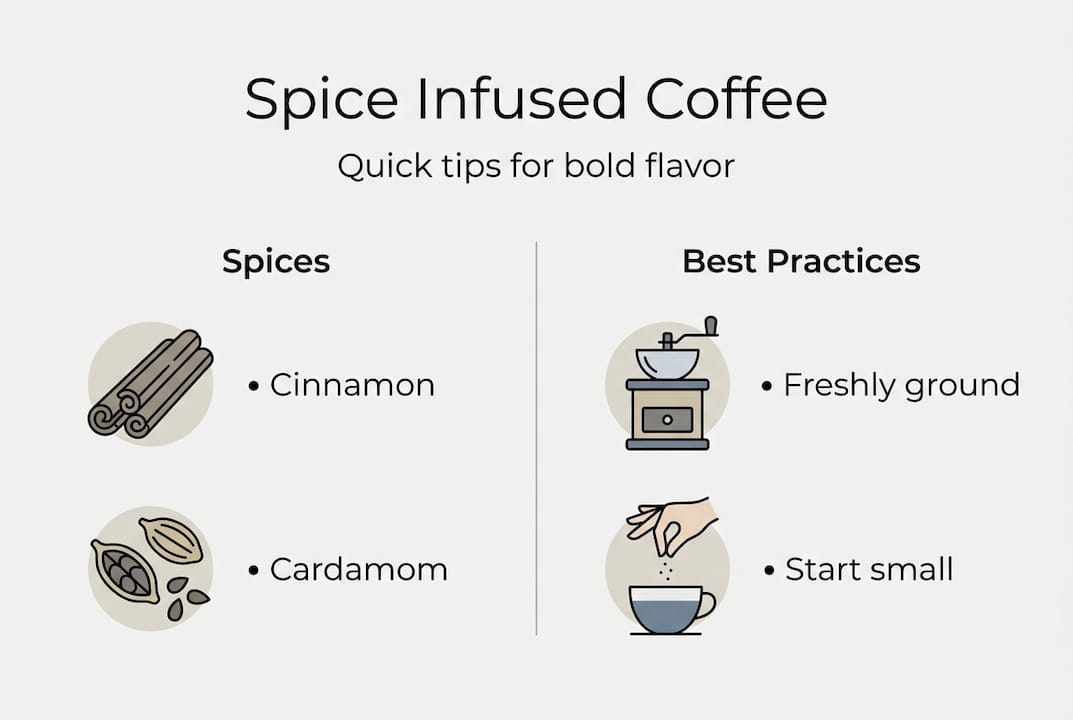
Successful spice infusion starts with quality ingredients and the right equipment. The most versatile spices are cinnamon, cardamom, ginger, nutmeg, and cloves, each bringing distinct warmth and aroma. Cinnamon adds sweet, woody notes that complement medium roasts beautifully. Cardamom delivers floral, citrusy complexity that pairs well with lighter beans. Ginger brings a spicy kick ideal for bold, dark roasts, while nutmeg and cloves offer deep, earthy undertones perfect for holiday-inspired blends.
Your coffee choice matters just as much as your spice selection. Medium to dark roasts like 6 bean blend provide a robust foundation that won’t be overpowered by spices, while lighter roasts allow delicate spices like cardamom to shine. Flavored coffees such as pumpkin spice already contain complementary notes, so adding extra spices can amplify those profiles or create entirely new dimensions.
Equipment requirements are straightforward. You’ll need a coffee grinder to ensure even particle size, which helps spices and grounds extract at the same rate. A French press or drip brewer works best for spice infusion because the coarser grind and longer contact time allow flavors to develop fully. Espresso machines and moka pots require caution, as fine grounds and high pressure can lead to clogging if you add too much spice.
Start with small quantities to dial in your preferred intensity. A quarter teaspoon of spice per cup is a safe baseline, but you can adjust based on the spice’s potency and your taste preferences. Whole spices like cinnamon sticks or cardamom pods need to be freshly ground for maximum aroma and control over texture.
Pro Tip: Grind your own spices fresh right before brewing. Pre-ground spices lose volatile oils quickly, resulting in muted flavors. A dedicated spice grinder or mortar and pestle ensures you capture the full aromatic punch.
Here’s a quick reference for pairing spices with coffee types:
| Spice | Best Coffee Type | Flavor Profile |
|---|---|---|
| Cinnamon | Medium roast | Sweet, woody, warm |
| Cardamom | Light to medium roast | Floral, citrusy, complex |
| Ginger | Dark roast | Spicy, zesty, bold |
| Nutmeg | Medium to dark roast | Earthy, rich, subtle |
| Cloves | Dark roast | Pungent, warming, intense |
With your spices, coffee, and tools ready, you’re set to move into the blending and brewing process that brings these flavors to life.
Step-by-step guide to blending and brewing spice infused coffee
Blending spices into your coffee grounds before brewing is the primary method for extracting flavors evenly without introducing grit. Follow these steps to achieve balanced, aromatic results every time.
-
Measure your spices. Start with 1/4 to 1/2 tsp per cup, scaling proportionally for larger pots. A 12-cup drip brewer would use 3 to 6 tsp total, depending on desired intensity.
-
Grind spices if using whole. Freshly ground cinnamon, cardamom pods, or whole cloves release more volatile oils than pre-ground versions. Aim for a texture slightly coarser than your coffee grounds to prevent over-extraction.
-
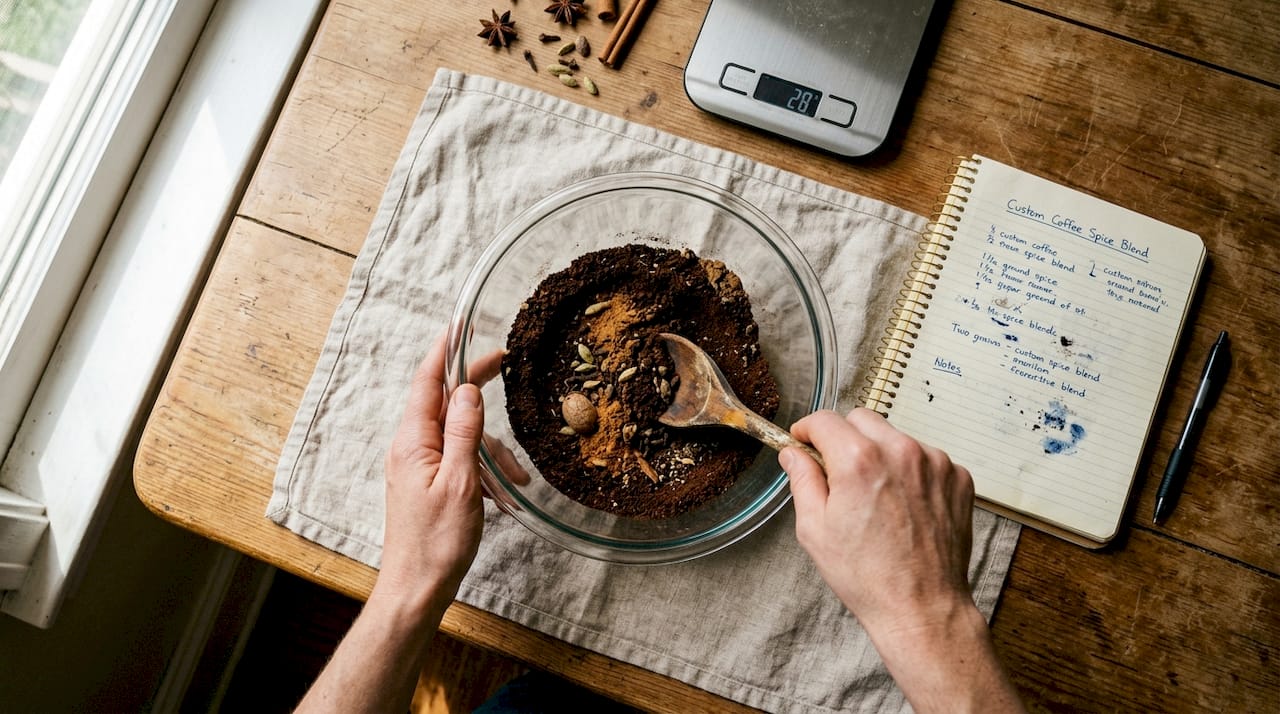
Mix spices with coffee grounds. Combine spices and grounds in a bowl or directly in your filter, stirring gently to distribute evenly. Uneven mixing results in some cups tasting over-spiced while others remain bland.
-
Brew with your preferred method. French press and drip brewers allow the longest contact time, giving spices ample opportunity to infuse. Pour hot water as you normally would, maintaining your usual brew time and temperature.
-
Avoid post-brew spice addition. Sprinkling spices on top of brewed coffee or stirring them in afterward creates a gritty texture and prevents full flavor extraction. The only exception is a light dusting of cinnamon as a garnish for visual appeal.
-
Taste and adjust. Your first batch is a baseline. If the spice flavor is too subtle, increase the quantity by 1/8 tsp increments in future brews. If it’s overpowering, reduce by the same amount.
Pro Tip: Keep a spice infusion journal. Note the coffee type, spice blend, quantities, and brewing method for each batch. Over time, you’ll identify your perfect ratios and discover which combinations work best with different beans, like pairing ginger with max caf blend for a morning energy boost or cardamom with holiday blend for festive warmth.
Here’s a reference table for scaling spice quantities:
| Brew Size | Coffee Grounds | Spice Amount (Mild) | Spice Amount (Bold) |
|---|---|---|---|
| 1 cup | 2 tbsp | 1/4 tsp | 1/2 tsp |
| 4 cups | 8 tbsp | 1 tsp | 2 tsp |
| 8 cups | 16 tbsp | 2 tsp | 4 tsp |
| 12 cups | 24 tbsp | 3 tsp | 6 tsp |
With the core blending and brewing process mastered, you’re ready to explore how different brewing methods and common mistakes can impact your spiced coffee experience.
Tips for different brewing methods and troubleshooting common mistakes
Each brewing method interacts with spices differently, requiring small adjustments to avoid equipment damage or flavor imbalance. Espresso machines and moka pots demand special care because their fine grind and high pressure make them prone to clogging if you add too much spice. Use only a pinch, roughly 1/8 tsp per shot, and grind spices slightly coarser than your coffee to reduce the risk of blocking the portafilter or valve.
Cold brew offers a completely different infusion profile. Steeping spices overnight with grounds extracts mellow, layered flavors that hot water can’t replicate. Cinnamon and cardamom work especially well in cold brew, as the extended contact time softens their sharpness while amplifying sweetness. Add 1 tsp of spice per cup of grounds, mix thoroughly, and steep for 12 to 24 hours in the refrigerator. Strain through a fine mesh or coffee filter to remove any residual spice particles.
Some brewers prefer adding spices after brewing for aroma control, but this approach has trade-offs. Post-brew addition preserves volatile aromatic compounds that might dissipate during hot extraction, but it also risks a gritty texture and weaker flavor integration. If you choose this method, use finely ground spices and stir vigorously, then let the coffee sit for 2 to 3 minutes before drinking to allow sediment to settle.
Common mistakes can derail even the best ingredients. Over-spicing is the most frequent error, turning a nuanced cup into an undrinkable medicinal brew. Always start conservatively and increase gradually. Uneven mixing leaves pockets of concentrated spice that create inconsistent flavor across the pot. Stir your spice and coffee blend thoroughly before adding water. Clogging equipment happens when fine spice particles accumulate in filters or valves, especially in espresso machines. Use coarser grinds and smaller quantities for high-pressure methods.
Pro Tip: Test small batches before committing to a full pot. Brew a single cup using your planned spice ratio, then scale up only if the results meet your expectations. This approach saves beans and prevents wasted coffee.
“Cinnamon boosts fruit notes but can dominate the profile if overused. Balance its intensity with coffee strength and milk choice to avoid overpowering the natural bean character.” – Mashed
Here’s a comparison of brewing methods and their spice infusion characteristics:
| Brewing Method | Spice Addition Timing | Pros | Cons |
|---|---|---|---|
| French Press | Mix with grounds | Full extraction, easy cleanup | Sediment may pass through mesh |
| Drip Brewer | Mix with grounds | Consistent results, no clogging | Less control over steep time |
| Espresso/Moka | Minimal, mix with grounds | Concentrated flavor | High clog risk, requires precision |
| Cold Brew | Steep overnight with grounds | Mellow, complex flavors | Long prep time, needs straining |
| Post-Brew | Stir into brewed coffee | Preserves aroma | Gritty texture, weak infusion |
Exploring products like cold brew coffee or instant coffee can simplify the process while still delivering quality results. With these method-specific tips and troubleshooting strategies in hand, you’re ready to experiment with creative spice blends and pairing ideas.
Creative spice blend recipes and pairing ideas
Once you’ve mastered the basics, crafting custom spice blends opens up endless flavor possibilities. Chai-inspired combinations like cinnamon, cardamom, and ginger transform strong brews into warming, aromatic experiences that rival any coffeehouse specialty. Start with equal parts of each spice, roughly 1/4 tsp per cup, and adjust based on which note you want to emphasize. More cinnamon adds sweetness, extra cardamom brings floral complexity, and additional ginger delivers a spicy kick.
Milk pairings amplify or soften spice profiles in surprising ways. Oat milk’s natural sweetness complements star anise and cloves, creating a dessert-like richness without added sugar. Almond milk’s nutty undertones enhance cinnamon and nutmeg, while coconut milk pairs beautifully with ginger and cardamom for a tropical twist. Whole milk’s fat content mellows intense spices like cloves, making them more approachable for everyday drinking.
Here are five creative spice blend recipes to try:
- Classic Chai: 1/4 tsp cinnamon, 1/4 tsp cardamom, 1/8 tsp ginger, pinch of cloves. Brew with masala chai for layered warmth.
- Mexican Mocha: 1/4 tsp cinnamon, 1/8 tsp cayenne, 1/8 tsp cocoa powder. Pairs perfectly with dark roasts for a spicy, chocolatey kick.
- Vanilla Nutmeg Latte: 1/4 tsp nutmeg, 1/8 tsp vanilla bean powder. Smooth and comforting with breakfast blend.
- Ginger Cardamom Cold Brew: 1/2 tsp cardamom, 1/4 tsp ginger. Steep overnight for a zesty, refreshing summer drink.
- Holiday Spice: 1/4 tsp cinnamon, 1/8 tsp nutmeg, 1/8 tsp cloves, pinch of allspice. Festive and warming for cozy mornings.
Balance spice intensity with coffee strength and milk choice to avoid overpowering the natural bean character. A bold dark roast can handle more aggressive spices like cloves and ginger, while a delicate light roast benefits from subtle touches of cardamom or vanilla.
Pro Tip: Cinnamon enhances fruit notes in naturally fruity beans, but use it cautiously. Too much cinnamon can mask the coffee’s inherent brightness and turn the cup one-dimensional.
“For adventurous home baristas, custom chai blends enrich strong brews, while pairing oat milk with star anise enhances profiles in unexpected ways.” – Coffee Voila
With these recipes and pairing strategies, you can personalize every cup to match your mood, season, or flavor craving. Now that you’ve learned how to blend spice infused coffee, it’s time to explore premium coffee options that elevate your creations even further.
Explore premium coffee blends to enhance your spice infused experience
Now that you’ve mastered spice infusion techniques, pairing them with high-quality coffee blends takes your results to the next level. Variatea Coffee offers small-batch roasts designed for adventurous brewers who crave bold, distinctive flavors. The max caf blend delivers a robust, high-caffeine foundation that stands up to intense spices like ginger and cloves, while the holiday blend features warming notes that complement cinnamon and nutmeg beautifully.

If you’re new to spice infusion or want to experiment with multiple profiles, the flavored coffees sample pack lets you test different bases without committing to full-size bags. Each blend is roasted to highlight unique characteristics that interact with spices in distinct ways, giving you the freedom to discover your signature combination.
Frequently asked questions
How much spice should I add to my coffee for the best flavor?
Optimal spice amount is small. Start with 1/4 to 1/2 tsp per cup and adjust based on taste. Over-spicing overwhelms the coffee’s natural profile, while too little leaves the flavor flat. Gradually increase by 1/8 tsp increments until you find your ideal balance.
Can I add spices after brewing my coffee instead of mixing with grounds?
Adding spices post-brew enhances aroma but often creates a gritty texture. Mixing spices with grounds before brewing yields deeper infusion and smoother results. If you prefer post-brew addition, use finely ground spices and let the coffee sit for a few minutes to allow sediment to settle before drinking.
What spices work best with cold brew coffee?
Cinnamon and cardamom are ideal for cold brew. Steeping them overnight with grounds extracts mellow, complex flavors that hot water can’t replicate. Use 1 tsp of spice per cup of grounds and strain thoroughly after 12 to 24 hours. Try pairing with cold brew coffee for a ready-made base.
How do I prevent spices from clogging my espresso machine?
Use minimal spice, roughly 1/8 tsp per shot, and grind it slightly coarser than your coffee. Fine spice particles accumulate in portafilters and valves, causing blockages. Test small amounts first and clean your machine regularly to avoid buildup that can damage equipment over time.