

How Coffee Aging Works: Science Behind the Flavor
TL;DR:
- Coffee aging involves chemical and physical changes—such as CO2 outgassing, oxidation, and moisture interaction—that influence flavor, aroma, and body. Intentional aging methods like natural, monsooned Malabar, and barrel aging shape distinctive profiles, while proper storage extends freshness and prevents unwanted staling. Adjusting brewing techniques based on the coffee’s age enhances extraction, emphasizing depth and smoothness over brightness and vibrancy.
Coffee aging is the process where beans undergo chemical and physical transformations over time, directly reshaping their flavor, aroma, and body in ways that range from subtle to dramatic. Whether you are drinking a freshly roasted single origin or a whiskey barrel aged specialty roast, the coffee aging process is already at work. The industry uses the term “post-harvest maturation” to describe intentional aging, but the same mechanisms govern natural staling too. Understanding how coffee matures gives you real control over what ends up in your cup, from choosing the right storage method to knowing exactly when a roast hits its flavor peak.
How coffee aging works at the chemical level
The core driver of coffee aging is CO2 outgassing. During roasting, beans generate enormous internal CO2 pressure, and that gas acts as a natural shield against oxygen. As CO2 degasses via first-order kinetics, oxygen penetrates the bean’s porous structure and oxidative staling accelerates, producing flat, papery, or rancid flavors. This is why freshly roasted coffee needs a short “rest” period before brewing but deteriorates sharply once that CO2 is gone.
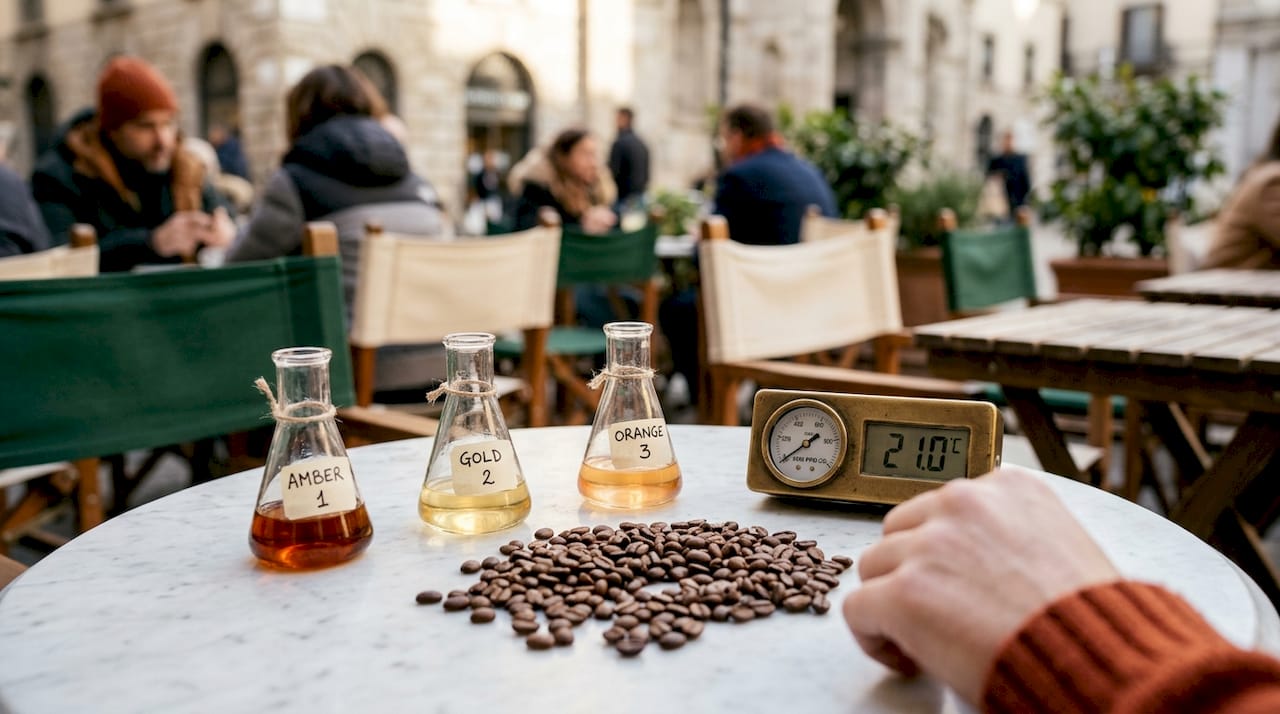
Oxidation is the second major force in the coffee aging process. Oxygen reacts with lipids on the bean surface through a process called lipid autoxidation, breaking down the fatty acids that carry rich, complex flavor. Simultaneously, volatile aroma compounds, the molecules responsible for floral, fruity, and nutty notes, begin evaporating the moment a bean is exposed to air. The 1,000-plus aroma compounds in a roasted bean are not equally stable, and the most delicate ones disappear first.
Moisture plays a different but equally significant role. Green beans are living seeds that interact continuously with their environment. Green coffee shelf life is a dynamic biological state governed by moisture content, water activity, and color change. Too much humidity accelerates microbial activity and fermentation; too little causes the bean to dry out and lose density. Managing moisture is the difference between intentional aging and simple spoilage.
The gap between whole bean and ground coffee aging is staggering. Grinding increases surface area by 500 to 1,000 times, which means CO2 escapes in seconds and oxygen floods in almost instantly. Ground coffee stales hundreds of times faster than whole bean, making grind timing one of the highest-leverage decisions any brewer can make.
Pro Tip: Grind immediately before brewing, not the night before. Even 30 minutes between grinding and brewing produces measurable aroma loss, especially for light roasts with high volatile compound concentrations.
What are the main coffee aging methods?
The effects of coffee aging depend almost entirely on how and where the aging happens. Three distinct methods produce three very different flavor outcomes.
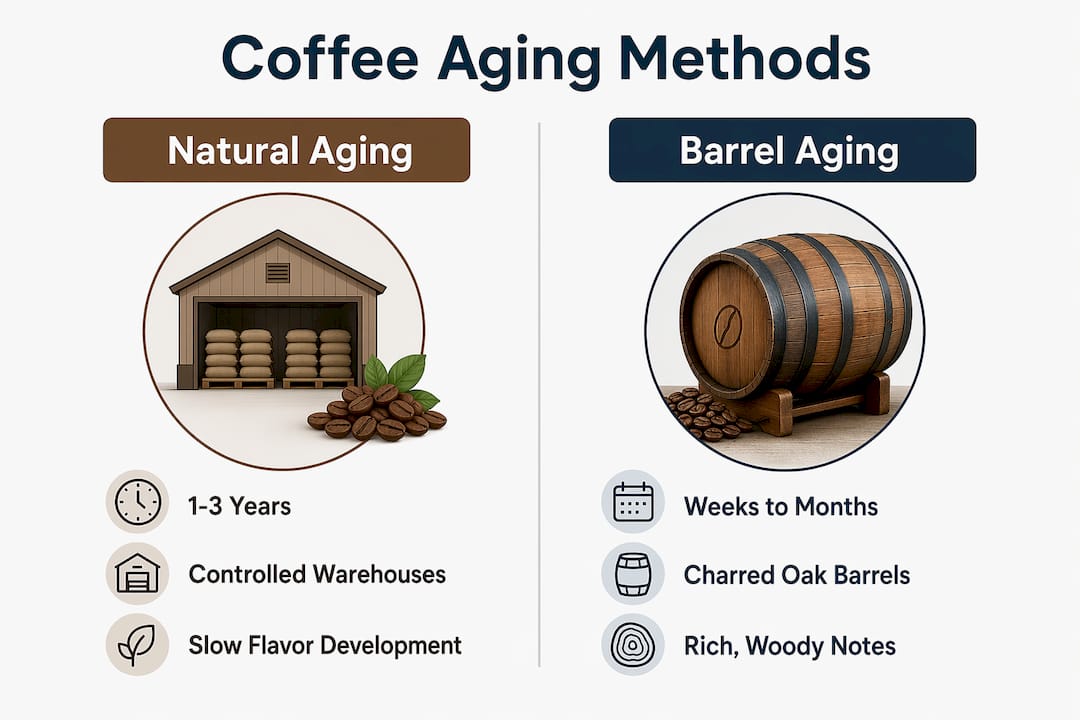
Natural aging stores green beans in controlled warehouse conditions for one to three years before roasting. The slow, stable environment allows gradual moisture equilibration and mild oxidation, which rounds out sharp acidity and deepens body. Indonesian and Indian coffees are frequently aged this way, producing earthy, woody, and low-acid profiles that appeal to drinkers who find bright, high-acid coffees too sharp.
Monsooned Malabar is the most dramatic natural aging method. Beans from India’s Malabar coast are exposed to monsoon winds for 12 to 16 weeks in open warehouses, absorbing ambient humidity and swelling to nearly double their original size. The result is a coffee with almost zero acidity, a syrupy body, and pronounced musty, spicy, and chocolate notes. It is one of the most polarizing flavor profiles in specialty coffee, and also one of the most memorable.
Barrel aging is the most controlled and intentional method. Roasted beans rest inside charred oak barrels previously used for bourbon, rum, or wine, absorbing volatile compounds from the wood. The contact time, wood type, and previous barrel contents all shape the final flavor. Variateacoffee’s Whiskey Barrel-Aged Coffee uses authentic charred oak barrels to layer smoky, vanilla, and bourbon notes onto the base roast without adding alcohol. This is how roasting transforms flavor at one stage, and barrel contact extends that transformation further.
| Method | Duration | Conditions | Typical flavor profile |
|---|---|---|---|
| Natural aging | 1 to 3 years | Controlled warehouse, stable humidity | Earthy, low acid, full body, woody |
| Monsooned Malabar | 12 to 16 weeks | Open warehouse, monsoon humidity exposure | Near-zero acidity, musty, spicy, syrupy |
| Barrel aging | Days to weeks | Sealed barrel contact post-roast | Smoky, vanilla, caramel, spirit notes |
| Fresh roast (no aging) | 0 to 4 weeks | Standard sealed packaging | Bright, fruity, floral, high acidity |
The contrast between aged and fresh-roasted coffee is not a quality judgment. It is a flavor preference. Fresh roasts deliver clarity and brightness; aged coffees deliver depth and smoothness. Both are valid, and knowing the difference lets you choose deliberately.
How does staling differ from intentional aging?
Staling and intentional aging share the same chemical mechanisms but differ in one critical factor: control. Intentional aging manages temperature, humidity, oxygen exposure, and time to guide flavor in a specific direction. Staling is what happens when those variables are left unmanaged.
Roasted coffee loses up to 84% of its character impact within 60 minutes after grinding. That number is not a warning about old coffee sitting on a shelf for months. It describes what happens in the hour after you grind a perfectly fresh bean. This means staling is not just a long-term storage problem. It is an immediate brewing concern.
The best storage practices work by limiting the four enemies of coffee freshness: heat, light, oxygen, and moisture. Here is how to address each one:
- Store whole beans in an airtight, opaque container at room temperature, away from direct sunlight and heat sources like stovetops.
- Use a container with a one-way CO2 valve, which lets outgassing CO2 escape without allowing oxygen in.
- Buy in quantities you will use within two to four weeks of the roast date to stay within the peak flavor window.
- If you must store coffee long-term, vacuum seal it and freeze it. Vacuum sealing combined with freezing is the only method that significantly slows thiol-melanoidin bonding and lipid autoxidation at room temperature.
- Never store coffee in the refrigerator without a vacuum seal. The fridge introduces moisture and absorbs odors from surrounding food.
High-altitude storage slows green coffee metabolism by maintaining stable humidity and temperature, preserving sugars and organic acids longer than low-altitude storage. This is the principle behind the Latin American practice of “reposo,” where green beans rest at elevation before export. The same logic applies at home: stable, cool, and dry beats fluctuating room conditions every time.
Pro Tip: Label your coffee containers with the roast date, not the purchase date. Roast date is what determines freshness. Most specialty roasters print it on the bag, and peak flavor for most roasts falls between 5 and 21 days post-roast.
For a deeper look at gourmet coffee storage, Variateacoffee covers the specific techniques that protect complex blends from premature staling.
How does aging change the brewing and tasting experience?
Aged coffee behaves differently in the brewer, and adjusting your technique to match the coffee’s age produces noticeably better results. The aging coffee impact on extraction is primarily about CO2 content and density. Fresh roasts off-gas during brewing, which can cause uneven extraction and a blooming effect. Aged beans have already released most of their CO2, so they extract more evenly and quickly.
This has several practical implications:
- Grind coarser for very fresh roasts. High CO2 creates resistance during extraction. A slightly coarser grind compensates and prevents over-extraction.
- Grind finer for aged beans. Lower CO2 means less resistance, so a finer grind maintains extraction balance.
- Reduce brew temperature slightly for barrel-aged coffees. The wood-derived compounds in barrel-aged beans extract faster than standard roasted compounds. Dropping water temperature by 3 to 5 degrees Fahrenheit prevents bitterness from dominating.
- Extend bloom time for fresh roasts. A 45-second bloom in pour-over brewing allows CO2 to escape before full extraction begins, producing a cleaner, more even cup.
Tasting aged coffee rewards patience and attention. The coffee tasting workflow for aged beans focuses on body and finish rather than brightness and aroma. Let the cup cool slightly before your first sip. Aged coffees often reveal their best notes, chocolate, dried fruit, smoke, or spice, at temperatures between 140 and 160 degrees Fahrenheit rather than at the scalding temperatures that mask subtlety.
Is aged coffee better? The honest answer is that it depends on what you value. Aged coffees offer complexity, smoothness, and depth that fresh roasts cannot replicate. Fresh roasts offer vibrancy, clarity, and aromatic intensity that no amount of aging can restore once lost. The most informed coffee drinkers keep both in rotation.
Key takeaways
Coffee aging is a chemical process driven by CO2 outgassing, oxidation, and moisture interaction, and managing those variables determines whether aging produces complexity or staling.
| Point | Details |
|---|---|
| CO2 outgassing drives aging | As CO2 leaves the bean, oxygen enters and oxidative staling begins, making timing critical. |
| Grinding accelerates staling 500 to 1,000x | Grind immediately before brewing to preserve volatile aroma compounds. |
| Intentional aging requires control | Monsooning, natural aging, and barrel aging each use specific conditions to guide flavor outcomes. |
| Storage limits staling | Airtight, opaque containers at stable temperatures protect freshness between roast and brew. |
| Aged coffee brews differently | Lower CO2 content means faster extraction; adjust grind size and temperature accordingly. |
Why I think most coffee drinkers misread aging entirely
Most people treat “aged coffee” as a marketing term for old beans that someone decided to sell anyway. That misreading costs them some of the most interesting flavor experiences in specialty coffee. Intentional aging is not about time passing. It is about controlling what time does to a bean.
The first time I tasted a properly monsooned coffee, I expected something musty and flat. What I got was a syrupy, almost savory cup with a finish that lasted longer than most espressos I had paid twice as much for. That experience reframed how I think about freshness. Freshness is not always the goal. Transformation is.
Barrel aging takes that idea further. The interaction between charred oak and roasted coffee is genuinely unpredictable in the best way. Two batches from the same barrel can taste different depending on how long the beans rested and how much residual spirit remained in the wood. That variability is a feature, not a flaw. It is what makes aged coffee worth exploring rather than just consuming.
My honest advice: stop chasing roast dates as the only marker of quality. Learn what each aging method does to flavor, then decide what you actually want in your cup. The answer will surprise you.
— Jonathan
Experience coffee aging firsthand with Variateacoffee

The most direct way to understand the aging coffee impact is to taste it. Variateacoffee’s Whiskey Barrel-Aged Coffee is aged in authentic charred oak barrels to layer deep smoky notes, bourbon warmth, and vanilla sweetness onto a carefully selected base roast. No alcohol, no artificial flavoring. Just the genuine result of wood contact and time. Every batch is roasted to order and shipped fresh, so you taste the aging without the staling. If you want to explore the full range of what intentional flavor transformation looks like, browse the complete collection and find the profile that matches your palate.
{% include youtube.html id=“mTyQWuYcg_k” %}
FAQ
What is the coffee aging process?
The coffee aging process refers to the chemical and physical changes beans undergo over time, including CO2 outgassing, oxidation, and moisture interaction. These changes alter flavor, aroma, body, and acidity in ways that can be intentionally guided or left unmanaged.
How fast does ground coffee go stale?
Ground coffee loses up to 84% of its character impact within 60 minutes of grinding due to rapid CO2 loss and oxygen penetration. Whole bean coffee stales hundreds of times more slowly, making grind timing one of the most impactful brewing decisions.
Is aged coffee better than fresh-roasted coffee?
Neither is objectively better. Fresh-roasted coffee delivers bright acidity and vivid aroma; intentionally aged coffee offers reduced acidity, deeper body, and complex flavor notes like chocolate, earth, or smoke. The right choice depends on your flavor preferences.
What is Monsooned Malabar coffee?
Monsooned Malabar is an Indian coffee aged by exposing beans to monsoon winds for 12 to 16 weeks in open warehouses. The process nearly eliminates acidity and produces a syrupy, spicy, and full-bodied cup unlike any standard roast.
How should I store coffee to slow aging?
Store whole beans in an airtight, opaque container away from heat and light, and use within two to four weeks of the roast date. For long-term storage, vacuum sealing combined with freezing is the most effective method for slowing oxidation and aroma loss.