

Flavor profiles: The key to artisan coffee and tea
TL;DR:
- A flavor profile is a structured description of a drink’s aroma, taste, and sensations from start to finish. Understanding these components enhances tasting precision, communication, and personal appreciation of artisan coffee and tea. While flavor perception is subjective, using tools like flavor wheels helps develop your sensory skills and vocabulary for better exploration.
Most people think flavor is just taste. Sweet, bitter, sour — a quick impression and move on. But the moment you bring a freshly brewed cup of Ethiopian Yirgacheffe to your nose before your first sip, something deeper happens. The aroma alone tells a story. What you’re experiencing is a flavor profile, and understanding it changes the way you drink coffee and tea forever. This guide walks you through exactly what flavor profiles are, how they work, and how you can use them to select, taste, and appreciate artisan blends at a completely different level.
Table of Contents
- What is a flavor profile and why does it matter?
- Core components of flavor profiles: From aroma to finish
- Flavor wheels and sensory lexicons: Making flavor profiles actionable
- Sample flavor profiles: Popular coffee and tea examples
- How to use flavor profiles for better tasting and selection
- The uncomfortable truth: Flavor is subjective but essential
- Discover unique coffee and tea blends with expert flavor profiles
- Frequently asked questions
Key Takeaways
| Point | Details |
|---|---|
| Flavor profile defined | A flavor profile is a structured description of a drink’s sensory attributes including taste, aroma, and finish. |
| Frameworks support communication | Sensory wheels and lexicons standardize language for flavor, reducing ambiguity between enthusiasts and pros. |
| Subjectivity remains key | No matter the framework, personal perception shapes every tasting experience. |
| Practical tasting steps | Using flavor profiles, you can mindfully observe, describe, and select artisan drinks with confidence. |
| Explore artisan blends | Browse curated selections for diverse, innovative coffee and tea flavor profiles. |
What is a flavor profile and why does it matter?
A flavor profile is not a marketing phrase roasters use to make a bag of coffee sound fancy. It’s a real, structured framework that maps out every sensory dimension of a drink from the first sniff to the final aftertaste. According to the Specialty Coffee Association, a flavor profile is a structured description of the flavors and sensory sensations a drink delivers, typically including aroma and taste attributes plus how they develop to the finish.
Think of it this way. A wine sommelier doesn’t just say “this tastes like grapes.” They describe tannins, acidity, fruit-forward notes, the finish on the palate, and the aromatic complexity on the nose. Coffee and tea deserve the same treatment, and flavor profiles give you the exact vocabulary to do it.
“Flavor is the combination of taste and smell. Treating them separately misses the whole picture.” This idea is central to how the SCA and professional tasters approach evaluation.
Flavor profiles matter for several reasons:
- They give you a reliable way to describe and remember drinks.
- They help roasters and producers communicate quality to buyers and enthusiasts.
- They allow you to match a drink to your personal preferences with real precision.
- They bridge the gap between poetic tasting notes (“tastes like a morning in the forest”) and standardized descriptions that mean the same thing to everyone.
Understanding coffee aroma explained is your first real step into flavor profile literacy, because aroma accounts for the vast majority of what we perceive as flavor.
With the foundation set, let’s break down the essential components inside every flavor profile.
Core components of flavor profiles: From aroma to finish
The SCA’s flavor wheel defines the key building blocks that make up a complete profile. Common components used to describe profiles include acidity/brightness, body/texture, flavor notes, and aftertaste/finish, with flavor itself defined as a combination of taste and smell organized from basic tastes to pure aromatics.
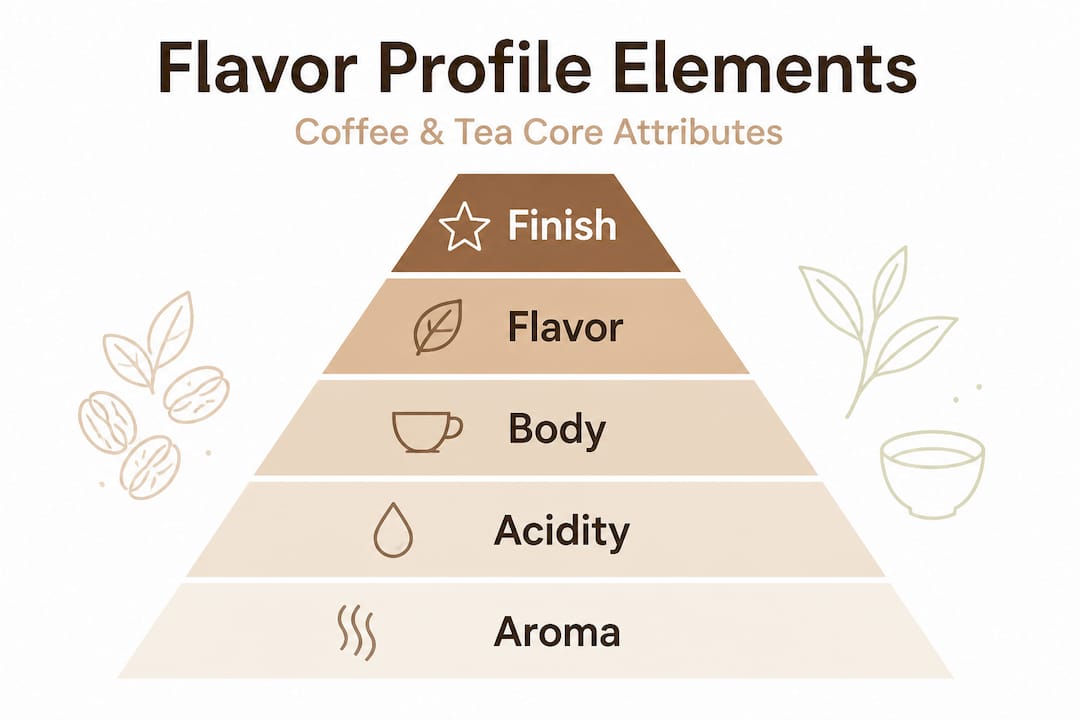
Here’s how each component works in practice:
| Component | What it describes | Example in coffee | Example in tea |
|---|---|---|---|
| Aroma | Scent before and during tasting | Floral, fruity, smoky | Grassy, roasted, floral |
| Acidity/Brightness | Lively or mellow mouth sensation | Bright citrus vs. mellow cocoa | Crisp briskness vs. smooth softness |
| Body/Texture | Mouthfeel and weight | Light and clean vs. full and creamy | Thin and delicate vs. rich and coating |
| Flavor notes | Specific taste impressions | Blueberry, caramel, cedar | Muscatel, honey, stone fruit |
| Finish/Aftertaste | Lingering sensation after swallowing | Clean, short vs. long, sweet | Dry, astringent vs. smooth, sweet |
The order in which these components appear during a tasting session is also important. Here’s a simple sequence that professional cuppers use:
- Smell the dry grounds or dry leaves before any liquid is added. This is your “dry aroma” and it’s often the most intense version of the fragrance.
- Smell the wet brew right after hot water is added. Volatile aromatic compounds bloom in the steam, revealing complexity.
- Take your first sip slowly, letting the liquid move across your entire palate rather than rushing it down.
- Notice the body — is the mouthfeel thin like water, silky like light cream, or heavy and coating?
- Identify flavor notes as specifically as you can. Don’t just think “fruity.” Ask yourself: is it citrus, stone fruit, or dried berry?
- Pay attention to the finish. After you swallow, does the flavor disappear instantly or linger in pleasant waves?
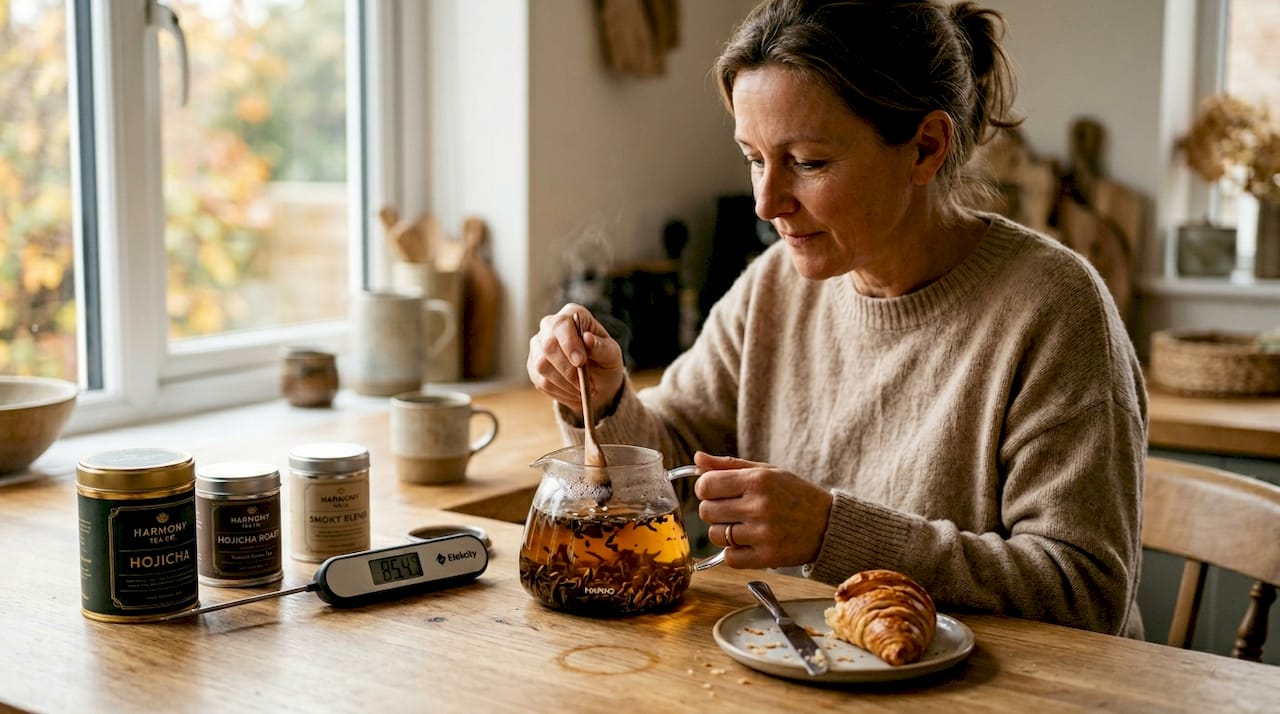
Pro Tip: Don’t taste cold. Brew coffee between 195 and 205 degrees Fahrenheit, and let tea steep at the temperature recommended for its variety. Flavor compounds that define artisanal coffee flavor profiles often only express themselves fully within precise temperature ranges.
The same logic applies to tea. Hojicha roasted green tea, for example, has a deeply toasty, caramel-like character that reveals itself differently at 165 degrees versus 190 degrees. The profile shifts depending on brew temperature, water quality, and steep time. These variables are not random. They’re part of the craft.
Understanding coffee aroma compounds in detail helps you recognize why the same bean processed differently can produce wildly different profiles, which is the heart of what makes specialty coffee so compelling.
Now that you understand the building blocks, let’s examine how professionals and enthusiasts use standard tools to create and communicate flavor profiles.
Flavor wheels and sensory lexicons: Making flavor profiles actionable
The SCA Coffee Taster’s Flavor Wheel is one of the most widely used tools in specialty coffee. It is a mainstream benchmark for naming and standardizing coffee flavor attributes using a common sensory vocabulary. The wheel starts at the center with broad taste categories and expands outward into increasingly specific descriptors, moving from “fruity” to “citrus” to “lemon” and finally to “lemon zest.”
Paired with the World Coffee Research Sensory Lexicon, the wheel creates a two-part system. The wheel gives you visual navigation. The lexicon gives you definitions, reference standards (actual physical food or chemical references you can smell or taste to calibrate your perception), and intensity scales.
Here’s a quick comparison of the two tools:
| Tool | Purpose | Best used for | Limitation |
|---|---|---|---|
| SCA Flavor Wheel | Visual navigation of descriptors | Quick naming and communication | Broad categories need interpretation |
| WCR Sensory Lexicon | Standardized definitions and references | Professional calibration and training | Requires access to reference standards |
Both tools are valuable, but they come with an important caveat. Flavor wheels and descriptors are tools for communication, but they can’t fully eliminate subjectivity because flavor arises from both taste and smell and depends on how the taster perceives and categorizes sensations.
Benefits of using flavor wheels:
- They give you a shared vocabulary with roasters and producers.
- They make it easier to compare drinks across brewing sessions.
- They help you discover which specific attributes you personally prefer.
- They turn vague impressions (“this is nice”) into specific observations (“bright malic acidity, medium body, dried apricot finish”).
The key is to use the wheel as a flexible guide, not a rigid script. If you genuinely taste something that isn’t on the wheel, trust it. You might be picking up on a compound or a combination unique to that specific batch, water chemistry, or brewing method. Learning how to cup coffee at home is the fastest way to build this sensory vocabulary from real experience rather than theory.
Let’s shift from frameworks to practical examples so you can see flavor profiles in action.
Sample flavor profiles: Popular coffee and tea examples
Nothing makes a concept click faster than a real example. Here are two detailed flavor profile descriptions that illustrate exactly how the framework applies to real drinks.
Ethiopia Yirgacheffe (washed process coffee):
- Aroma: Jasmine, bergamot, and fresh-cut lemon
- Acidity: Bright, almost sparkling, with a clean citrus edge
- Body: Light to medium, tea-like in texture
- Flavor notes: Lemon verbena, honey, white grape
- Finish: Clean, short, with a faint sweet floral aftertaste
Darjeeling first flush black tea:
- Aroma: Muscatel (a distinctive grape-like, floral scent unique to Darjeeling)
- Acidity: Lively and brisk, particularly prominent when brewed short
- Body: Light and delicate
- Flavor notes: Fresh-cut flowers, stone fruit, subtle green character
- Finish: Long, smooth, with a lingering sweet and slightly astringent close
These descriptions use the same structural framework but produce entirely different portraits. That’s the power of flavor profiling. Using an established sensory lexicon reduces ambiguity and improves communication across roasters and consumers, while still leaving room for the personality of each drink to come through.
Pro Tip: When tasting something new, resist the urge to immediately check what the roaster’s notes say. Form your own impression first. Then compare. You’ll be surprised how often your perception aligns, and how interesting it is when it doesn’t. This practice builds real sensory skill over time.
You can apply this exact same method to explore coffee flavor tips for a wide range of roast levels, and use it equally well when working through exotic tea blends that fall outside what most people encounter on a standard grocery shelf. Understanding coffee flavor variety also shows how origin, processing method, and roast level combine to create fundamentally different profiles from the same species of plant.
With practical examples in mind, let’s look at how you can use flavor profiles to elevate your own tasting experiences and deepen your appreciation of artisan drinks.
How to use flavor profiles for better tasting and selection
Knowing the theory is one thing. Putting it to work in your kitchen is another. Here’s a repeatable, six-step tasting process you can apply to any coffee or tea, from a single-origin Ethiopian natural process to a Japanese Hojicha or a brisk Moroccan Mint blend.
- Prepare intentionally. Use filtered water, the right temperature, and clean equipment. Residual oils or soap residue in a cup will distort your perception significantly.
- Observe the aroma before tasting. Inhale slowly over the cup with your eyes closed. Identify at least one aroma descriptor before you sip anything.
- Take a small first sip and hold it briefly. Let the liquid coat your whole palate before swallowing. Notice the initial impression, the mid-palate flavor, and the finish separately.
- Evaluate the body. Swirl the drink slightly in your mouth. Does it feel watery, round, creamy, or almost chewy? This tells you a lot about processing and roast level.
- Name the flavor notes using a wheel. Start broad (“fruity, nutty, floral”) and work inward to specific descriptors (“dried cherry, roasted almond, jasmine”).
- Record your impressions immediately. Memory for flavor fades fast. A quick written note with date, drink name, brew method, and your profile description becomes an invaluable personal reference over time.
The SCA describes the wheel as intuitive and usable for both casual tasting and professional cupping, tied to the World Coffee Research Sensory Lexicon with defined attributes and references. This means the same tool that world-class Q Graders use is equally accessible for home brewers who are just starting to explore artisan flavor discovery.
Pro Tip: Invite a friend to taste the same drink separately, write down your own profiles without comparing, and then share. The differences and similarities in your notes reveal how personal flavor perception truly is, and the conversation itself deepens your tasting skill faster than solo practice alone.
Now that you’re equipped to understand and use flavor profiles, it’s time for a deeper perspective on why flavor profiling matters and how to make it work for you.
The uncomfortable truth: Flavor is subjective but essential
Here’s something most tasting guides won’t say directly: no flavor wheel, however well designed, will tell you what something actually tastes like to you. Flavor wheels and descriptors are tools for communication, but they can’t fully eliminate subjectivity because flavor arises from both taste and smell and depends on how the taster perceives and categorizes sensations.
We think that’s actually wonderful news.
Flavor profiling is equal parts art and science. The science gives you structure, vocabulary, and a way to communicate. The art is the part where your palate, your memory, and your personal history with food and drink shape what you actually experience. Someone who grew up eating ripe mangoes in Southeast Asia will perceive “tropical fruit” notes in a natural-process coffee completely differently than someone who first encountered that flavor in a grocery store smoothie. Neither perception is wrong.
What frustrates us is when people treat the flavor wheel as a test to pass rather than a map to explore. The moment tasting becomes about getting the “right answer,” you lose the genuine sensory engagement that makes artisan coffee and tea worth pursuing in the first place. Explore the full range of specialty coffee flavors and you’ll quickly realize that the best moments happen when something surprises you, when a Hojicha reads like caramel and roasted wood in a way you never expected from tea, or when a Whiskey Barrel-Aged Coffee delivers that deep, smoky bourbon character without a drop of alcohol.
Use the frameworks. Learn the vocabulary. Then set them aside when your own palate leads you somewhere interesting. That’s where real mastery lives.
Discover unique coffee and tea blends with expert flavor profiles
Ready to put these ideas into practice with drinks that actually push the boundaries of what coffee and tea can be? At Variatea Coffee, every blend is built around a distinct, intentional flavor profile — not an afterthought.

Explore our tea collections featuring everything from Hojicha and Matcha to Moroccan Mint and Hibiscus Berry, each with detailed tasting notes so you know exactly what you’re brewing. Or try our whiskey barrel-aged coffee, a non-alcoholic roast aged in charred oak barrels that delivers smoky bourbon and vanilla notes unlike anything you’ll find on a standard grocery shelf. Every product is a hands-on opportunity to apply what you’ve learned here and discover what your palate truly loves.
{% include “youtube” id=“mTyQWuYcg_k?si=wPv_8KdEmtrXq5gP” %}
Frequently asked questions
How do I identify the flavor notes in coffee or tea?
Start by smelling before you sip, then use a flavor wheel to match your impressions to standardized vocabulary. The SCA defines “flavor” as taste plus smell and emphasizes moving through mindful tasting stages rather than rushing to a single conclusion.
Can flavor profiles be used for tea as well as coffee?
Yes, the same framework applies to both. A flavor profile describes the sensory sensations any complex drink delivers, and tea has just as much aromatic and textural complexity as specialty coffee.
Why do people experience flavors differently?
Individual sensory biology, personal food memory, and the way each person interprets aroma all influence perception. Flavor wheels and descriptors help create shared language but cannot eliminate the natural subjectivity built into how we taste and smell.
What are the main elements of a flavor profile?
The core elements are aroma, acidity, body, flavor notes, and finish. Common components in coffee profiling cover all of these, from brightness and texture to specific taste attributes and the lingering aftertaste after you swallow.
Recommended
- Artisanal coffee flavor profiles and brewing techniques – Variatea Coffee
- Top coffee flavor tips for adventurous enthusiasts – Variatea Coffee
- Explore artisan coffee varieties for unique flavor experiences – Variatea Coffee
- Why specialty coffee unlocks flavor you can’t get elsewhere – Variatea Coffee