

Your Expert Guide to Exotic Coffee Tasting at Home
TL;DR:
- Setting up a consistent, well-equipped environment is essential for accurate coffee tasting.
- Following precise brewing and tasting protocols enhances flavor recognition in exotic coffees.
- Embracing personal perception and curiosity fosters a more enjoyable, authentic coffee tasting experience.
Exotic coffees can feel intimidating when you first pop open a bag labeled with tasting notes like “dried apricot, cedar, and dark molasses.” You smell it, brew it, sip it, and think: I just taste coffee. That disconnect between what the experts describe and what your palate actually registers is one of the most common frustrations among adventurous brewers. The good news is that confident flavor recognition is a skill, not a gift. This guide walks you through exactly how to set up, execute, and document a professional-grade tasting session at home, so you can stop guessing and start genuinely tasting the rare, complex flavors hiding in every cup.
Table of Contents
- What you need to start your exotic coffee tasting journey
- How to prepare and brew exotic coffees for tasting
- The tasting process: Savoring and documenting exotic flavors
- Common mistakes and troubleshooting during your tasting session
- Why embracing imperfection unlocks the true magic of coffee tasting
- Explore rare and premium coffee experiences with Variatea
- Frequently asked questions
Key Takeaways
| Point | Details |
|---|---|
| Gather the right tools | Identical cups and a scale help keep your tasting consistent and fair. |
| Brew side-by-side samples | Comparing 2-4 exotic coffees at once sharpens your sensory skills. |
| Trust your palate | Reference the flavor wheel but always rely on your own taste experience. |
| Document flavor changes | Take notes as your coffee cools to spot evolving, subtle flavors. |
| Embrace imperfection | Enjoy the process and occasional surprises—subjective experiences make tasting memorable. |
What you need to start your exotic coffee tasting journey
A great tasting session starts long before the first sip. Your environment, tools, and bean selection all shape what you actually perceive in the cup. Think of it the way a sommelier thinks about wine tasting: the setup is half the work.
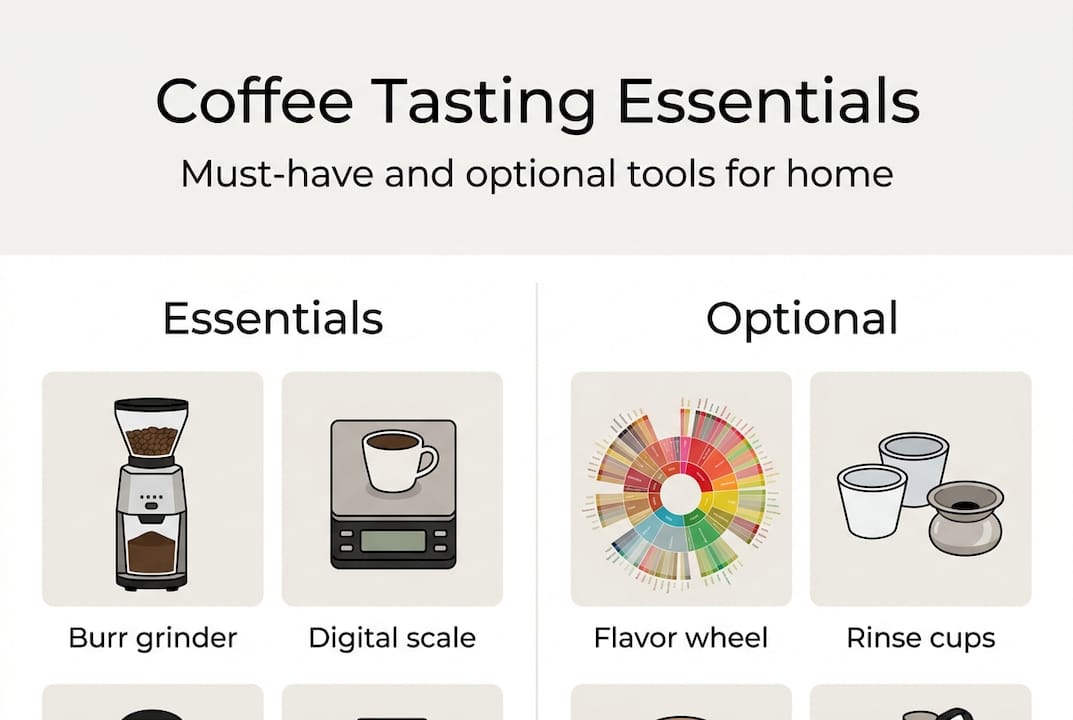
For gear, you need the following core items:
- Burr grinder (blade grinders produce uneven particle sizes that muddy flavors)
- Digital scale (accurate to 0.1 grams)
- Gooseneck kettle with temperature control
- Filtered or neutral water (tap water with chlorine distorts delicate notes)
- Timer
- Identical cups or cupping bowls (uniformity removes visual bias)
- Cupping spoons (wide, round bowls for proper slurping)
- Tasting notepad or form
Optional but genuinely useful extras include a coffee flavor wheel, a thermometer, and small rinse cups for water between samples.
| Item | Essential | Optional |
|---|---|---|
| Burr grinder | Yes | |
| Digital scale | Yes | |
| Gooseneck kettle | Yes | |
| Flavor wheel | Yes | |
| Cupping bowls | Yes | |
| Thermometer | Yes | |
| Notepad/form | Yes |
For beans, choose at least two contrasting exotic varieties. Pairing something fruity and bright, like an Ethiopian natural process, against something earthy and smoky, like our Whiskey Barrel-Aged roast, sharpens your ability to distinguish individual characteristics. Contrast is your best teacher.
Pro Tip: Use identical cups for every sample. Even small differences in cup shape or material can shift your perception of acidity and body, skewing your results before you take a single sip.
The SCA protocol for objective tasting is a globally recognized method used by professional cuppers and competition judges alike. Following its structure, even loosely, gives your home session a reliable, repeatable framework rather than a casual guess.
How to prepare and brew exotic coffees for tasting
With your gear and beans ready, perfect preparation is the next step toward a rewarding tasting session. Consistency between each sample is non-negotiable. If one cup is ground coarser, brewed hotter, or steeped longer than another, you are not comparing coffees anymore. You are comparing mistakes.
Follow these steps for each sample:
- Weigh your beans. Use a 1:15 coffee-to-water ratio as your baseline. For a standard cupping bowl, that means 12 grams of coffee to 180 ml of water.
- Grind fresh. Grind each coffee immediately before brewing, using a medium-coarse setting. Rinse the grinder briefly between different beans to avoid flavor carry-over.
- Heat your water. Target 200°F (just off the boil). This temperature extracts a wide range of flavor compounds without scorching delicate aromatic notes.
- Pour evenly. Saturate all grounds in each cup simultaneously, or as close to it as possible. Start your timer the moment water hits the coffee.
- Steep for 4 minutes. Do not stir or disturb the crust that forms on top.
- Break the crust and skim. At four minutes, gently stir the crust on each cup and skim off floating grounds with two spoons.
The key consistency tips to keep in mind:
- Side-by-side comparison of 2 to 4 coffees gives you the clearest picture of how each bean differs
- Use the same water temperature across every cup
- Clean and dry your grinder, kettle, and spoons between samples
- Label each cup clearly so you can reference your notes accurately
Understanding coffee flavor layering before you begin will help you know what to look for as each brew develops. And if you want to dig deeper into brew methods that maximize flavor expression, exploring artisanal brewing techniques will give you a serious advantage.
Pro Tip: Set a visible timer and commit to identical steep times for every cup. Even a 30-second difference in extraction changes what you taste, making honest comparison almost impossible.
The tasting process: Savoring and documenting exotic flavors
Now that your coffees are brewed, it is time to dive into the tasting ritual itself. This is where the real discovery happens. Move through each cup systematically rather than jumping between them randomly.
Here is the tasting sequence to follow:
- Smell the dry grounds. Before adding water, inhale the aroma of each ground coffee. Note what comes to mind: fruit, earth, chocolate, wood?
- Smell the wet crust. Right after pouring, lean in and breathe deeply. The steam carries volatile aromatics that disappear quickly.
- Break the crust. As you stir it open, smell again. This is often the most dramatic aromatic moment of the entire session.
- Slurp aggressively. Use your cupping spoon to draw coffee across your entire palate. A loud, aerated slurp is not rude here. It coats your tongue evenly and volatilizes aromas into your nasal cavity.
- Score and note. Immediately write down what you perceive: flavor, acidity, body, sweetness, finish.
- Taste again as it cools. This is critical.
How flavors evolve as the coffee cools is one of the most surprising discoveries for new tasters. Bright fruit notes often only emerge below 140°F. Bitterness softens. Hidden sweetness appears.

Here is how two contrasting exotic coffees might look side by side in your notes:
| Attribute | Ethiopian Natural | Whiskey Barrel-Aged |
|---|---|---|
| Aroma | Blueberry, jasmine | Oak, vanilla, smoke |
| Flavor (hot) | Berry, brown sugar | Dark chocolate, cedar |
| Flavor (cool) | Stone fruit, wine | Caramel, dried fig |
| Body | Light, silky | Heavy, velvety |
| Finish | Bright, clean | Long, smoky |
Using a flavor wheel as a reference helps when you need vocabulary, but do not let it override your senses. For sharper coffee flavor tips on building your palate vocabulary, practice naming what you taste before checking the wheel.
“Use the flavor wheel as a starting point, not a rulebook. Your palate is the final authority.”
Tracking how you experience flavor evolution across a full session also helps you understand which brewing variables affect your favorite characteristics most. And when it comes to choosing unique blends for your next session, your documented notes become a genuinely useful reference.
Common mistakes and troubleshooting during your tasting session
Even with a solid process, a few common slip-ups can disrupt your tasting results. Many beginners, as noted in cupping preparation guidance, fail to prepare neutral palates or use inconsistent tools, which quietly ruins an otherwise careful session.
Here are the most frequent mistakes and how to fix them fast:
- Palate fatigue: Tasting too many coffees back to back dulls your receptors. Fix: Limit sessions to four samples maximum and take breaks between cups.
- Flavored or mineral-heavy water: Strong minerals compete with coffee compounds. Fix: Use filtered water or a neutral bottled water with low mineral content.
- Cross-contamination between samples: Residual coffee in your spoon or grinder skews the next cup. Fix: Rinse tools with hot water and dry thoroughly between each sample.
- Rushing the process: Moving too quickly between cups means you miss flavor evolution and lose track of your notes. Fix: Allow at least five minutes per sample before moving to the next.
- Scented environments: Candles, cleaning products, or even strong cologne in the room interfere with aroma perception. Fix: Taste in a neutral, odor-free space.
“Consistency and patience are your best tools for honest results.”
Pro Tip: Eat a plain, unsalted cracker between coffees to cleanse your palate. It resets your taste receptors more effectively than water alone and keeps your evaluations clean across the session.
Understanding the craft behind your beans also sharpens your ability to taste them accurately. Reading about coffee blending techniques gives you context for why certain flavors exist in a blend. And if you want to take the experience further, exploring coffee cocktail applications shows you how flavor knowledge translates into entirely new creative directions.
Why embracing imperfection unlocks the true magic of coffee tasting
With the practical steps and pitfalls in mind, it is worth reconsidering what true success in coffee tasting actually looks like. There is a temptation, especially after reading about SCA protocols and flavor wheels, to treat every session as a test you can pass or fail. That mindset quietly kills the joy.
The protocols are a starting point, not a finish line. Every palate is built differently, shaped by your diet, your memories, your culture. What registers as “bright citrus” to one person tastes like “green tea” to another, and both people are right. Getting it “wrong” by the textbook standard often leads you somewhere far more interesting: a new favorite, an unexpected pairing, or a conversation you would not have had otherwise.
The adventurous brewer who explores an artisan coffee cupping guide and then goes off-script is not doing it wrong. They are doing it honestly. Openness to surprise is the entire point of tasting exotic coffee. If every cup confirmed your expectations, you would just buy the same bag forever.
Explore rare and premium coffee experiences with Variatea
You have the framework. Now put it to work with beans genuinely worth tasting.

Variatea Coffee was built exactly for this kind of adventurous session. Our Whiskey Barrel-Aged Coffee is a perfect anchor for any tasting flight, with its layered oak, vanilla, and smoky bourbon character that evolves dramatically as it cools. Pair it alongside our Gourmet Donut Shop blend for a striking contrast in sweetness and body. And if you want to bring tea into your tasting rotation, our collection of artisanal teas including Hojicha, Matcha, and Moroccan Mint offers a completely new dimension to explore. Every bag is crafted for the brewer who wants something worth noticing.
Frequently asked questions
What is the SCA protocol in coffee tasting?
The SCA protocol is a standardized method used globally to objectively evaluate and compare coffee flavors, scoring attributes like aroma, body, acidity, and finish on a consistent scale.
How many coffees should I taste at one session?
For clarity and enjoyment, start with two to four exotic coffees side by side. More than four samples in one sitting typically leads to palate fatigue and unreliable notes.
Why does coffee taste different as it cools?
Many flavor compounds emerge at lower temperatures, which is why fruit, sweetness, and nuanced acidity often become more pronounced as your cup moves from hot to warm.
Do I need special cups or tools for tasting?
While standard cups work, using identical cups and a scale removes variables that can unintentionally skew your perception of body and flavor balance between samples.
Recommended
- Unlock Coffee Cupping: Discover Artisan Flavors at Home – Variatea Coffee
- What is a home barista? Your guide to cafe-style brews – Variatea Coffee
- Home coffee cocktails: specialty beans make the difference – Variatea Coffee
- Unlock unique coffee rituals: expert brews & premium flavor – Variatea Coffee