

Coffee complexity: A guide to rich flavors and artisanal brews
Most people assume the best coffee is simply the strongest. Bold, dark, and intense. But strength is just volume. What separates a truly premium cup from an ordinary one is complexity, the ability to deliver multiple distinct flavors, aromas, and sensations that shift and evolve from the first sip to the last. If you’ve ever tasted a coffee that seemed to change as it cooled, revealing notes of fruit, chocolate, or spice you didn’t expect, you’ve already experienced complexity. This guide breaks down exactly what that means, how professionals measure it, and how you can seek it out in your own brewing practice.
Table of Contents
- Defining coffee complexity: Layers, intensity, and aroma
- How professionals score complexity: SCA and CVA approaches
- The flavor journey: Experiencing complexity in coffee at home
- Elevating your coffee experience: Applying complexity to selection and brewing
- Experience premium complexity with Variatea Coffee
- Frequently asked questions
Key Takeaways
| Point | Details |
|---|---|
| Complexity is layered flavor | True coffee complexity means multiple flavors and aromas evolving in each brew. |
| SCA scoring benchmarks | Professionals use SCA and CVA protocols to rate complexity and quality for specialty coffees. |
| Taste and brew for complexity | Enthusiasts can identify and enhance complexity with mindful tasting, origin selection, and brewing technique. |
| Home application | You can experience premium complexity at home by experimenting with blends and cupping methods. |
Defining coffee complexity: Layers, intensity, and aroma
Complexity in coffee isn’t a vague compliment. It’s a specific, measurable quality that refers to the presence of multiple discernible flavors and scents working together in a single cup. Think of it like a chord in music. One note is clear and pleasant. Three notes played together create something richer, more interesting, and harder to forget.
Professionals evaluate artisanal coffee flavors using structured cupping protocols developed by the Specialty Coffee Association (SCA). Within those protocols, complexity is evaluated within the Flavor attribute, which carries a maximum of 10 points, where evaluators assess the intensity, quality, and complexity of combined taste and retronasal aromas. Retronasal aroma is the scent you perceive through the back of your throat while drinking, not just through your nose. It’s a major driver of flavor depth.
A complex coffee typically balances several key attributes at once:
- Acidity: Brightness that lifts the cup and adds liveliness
- Sweetness: Natural sugars that round out sharp edges
- Aromatic layers: Floral, fruity, or spiced notes detected before and during the sip
- Retronasal finish: Lingering aromas that evolve after swallowing
- Aftertaste: How long and how pleasantly the flavor stays with you
“Complexity is not about overwhelming the palate. It’s about giving the palate somewhere interesting to go.”
Learning to master flavor layering is what separates casual coffee drinkers from true enthusiasts. Once you understand what to look for, every cup becomes a tasting experience rather than just a caffeine delivery system. And enhancing coffee flavors at home starts with knowing which attributes to pay attention to.
How professionals score complexity: SCA and CVA approaches
Knowing what complexity is and knowing how it’s scored are two different things. Let’s look at how the industry actually puts numbers to this quality.
The SCA scoring system ranks specialty coffee on a 100-point scale. Score benchmarks place 90 to 100 as “Outstanding” for exceptional complexity, 85 to 89.99 as “Excellent,” and 80 to 84.99 as “Very Good.” Only coffees scoring 80 or above qualify as specialty grade. Complexity is baked into the Flavor attribute, which means a coffee with flat, one-dimensional taste simply cannot score high.
In 2025, the SCA introduced the Coffee Value Assessment (CVA), a revised framework that separates intensity from preference, eliminating the traditional numeric total score. Instead of one combined number, the CVA uses calibrated descriptors to distinguish objective intensity from subjective enjoyment. This is a significant shift in how the industry thinks about quality.
| Feature | SCA scoring | CVA (2025) |
|---|---|---|
| Score format | Numeric total (0 to 100) | Descriptive, no total score |
| Complexity focus | Embedded in Flavor attribute | Separated by intensity and preference |
| Objectivity | Blends quality and preference | Prioritizes calibrated objectivity |
| Accessibility | Familiar benchmark system | More nuanced, less intuitive |
| Best for | Comparing coffees broadly | Detailed sensory analysis |
The best coffees for flavor tend to score well under both systems, but the CVA debate highlights something important: complexity is partly objective (measurable intensity) and partly personal (what you find pleasurable). Both matter.
Here’s how to start applying professional thinking at home:
- Print or sketch a simple scoring sheet with attributes: aroma, flavor, acidity, sweetness, aftertaste.
- Brew two different coffees side by side, ideally from different origins.
- Score each attribute from 1 to 10 based on intensity and quality.
- Note which coffee has more distinct, evolving layers.
- Compare your scores and identify what drove the difference.
Pro Tip: Don’t score based on what you like most. Score based on what you detect. Preference and complexity are separate things, just like the CVA now formally recognizes. Exploring unique coffee blends and coffee blending techniques will sharpen your ability to detect those differences fast.
The flavor journey: Experiencing complexity in coffee at home
Scoring sheets are useful, but the real education happens in the cup. Here’s how to actually taste complexity rather than just read about it.

Start with aroma before you take a single sip. Smell the dry grounds, then smell the cup after hot water hits them. You’re looking for layers, not just one dominant scent. Fruity and floral notes tend to appear first. Earthy, chocolatey, or spiced notes often emerge as the cup cools.
As you taste, pay attention to how the flavor changes across the sip. The front of your palate picks up sweetness and acidity. The middle registers body and texture. The back delivers bitterness and the beginning of the finish. A complex coffee keeps all three zones engaged. A simple coffee peaks early and fades.
The SCA Flavor attribute evaluates exactly this: the intensity, quality, and complexity of combined taste and retronasal aromas. That retronasal element is what makes a great coffee linger in a satisfying way.
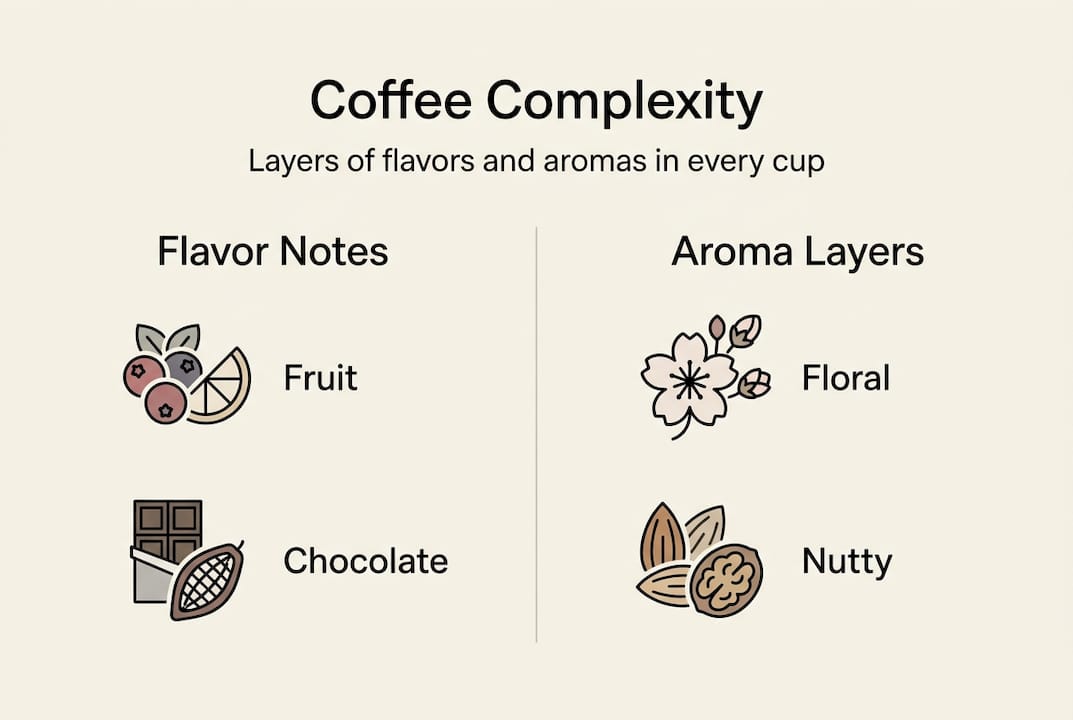
Here’s a quick reference for common complexity descriptors:
| Flavor category | Common notes | What it signals |
|---|---|---|
| Fruity | Citrus, berry, stone fruit | High acidity, bright complexity |
| Floral | Jasmine, rose, lavender | Delicate aromatic layers |
| Nutty/Chocolatey | Almond, cocoa, hazelnut | Roast-driven depth |
| Spiced | Cinnamon, clove, cardamom | Origin or blend character |
| Earthy/Woody | Cedar, tobacco, soil | Processing and terroir influence |
Brew method matters enormously. A pour-over highlights clarity and individual flavor notes. A French press adds body and blurs the edges between layers. Espresso concentrates everything, amplifying both complexity and any flaws. Understanding your coffee blend guide helps you match the right method to the right coffee.
- Try spice infused coffee tips to add intentional aromatic layers to your brew
- Explore a flavored coffee sample pack to compare complexity across multiple profiles at once
- Adjust grind size finer for more extraction and more flavor development
Pro Tip: Brew the same coffee at two different water temperatures, 195°F and 205°F, and taste them side by side. You’ll be surprised how much temperature alone shifts the complexity you perceive.
Elevating your coffee experience: Applying complexity to selection and brewing
Now that you can recognize complexity, the next step is actively choosing and brewing for it. This is where your knowledge becomes a real advantage.
When selecting beans, look for coffees with SCA scores of 85 or above for excellent complexity, and 90 or above for truly outstanding layered experiences. Single-origin coffees from Ethiopia, Colombia, or Yemen tend to offer natural complexity driven by terroir. Blends, when crafted well, can layer complementary profiles for even greater depth.
Here’s a step-by-step approach to brewing for maximum complexity:
- Choose intentionally: Select a coffee with tasting notes that span at least two flavor categories, such as fruity and chocolatey.
- Grind fresh: Pre-ground coffee loses volatile aromatic compounds fast. Grind right before brewing.
- Control your water: Use filtered water at 195°F to 205°F. Mineral content affects extraction and flavor clarity.
- Slow down the pour: For pour-over methods, a slow, even pour extends extraction time and pulls more complexity from the grounds.
- Let it cool slightly: Many complex flavors emerge as coffee drops from scalding to warm. Don’t rush the first sip.
For a practical tasting exercise, brew three coffees from different origins back to back. Score each one on aroma, flavor layers, acidity, and aftertaste. Then try flavor layering at home by blending two of them in a 70/30 ratio and tasting the result. You’ll immediately hear the chord instead of the single note.
If you want a ready-made example of engineered complexity, the Max Caf Blend is a strong starting point. It’s built for intensity and layered flavor, giving you a clear benchmark to taste against.
- Pay attention to roast level: light roasts preserve origin complexity, dark roasts develop roast-driven complexity
- Single-origin coffees reveal terroir; blends reveal craft
- Freshness matters: buy in small batches and use within three weeks of roast date
Experience premium complexity with Variatea Coffee
If this guide has sharpened your appetite for layered, evolving flavors, the next step is putting that knowledge into practice with coffees built for exactly that purpose.

At Variatea Coffee, every product in our coffee collections is designed with complexity in mind. Our Whiskey Barrel Aged coffee is a standout example: aged in authentic charred oak barrels, it delivers smoky, vanilla, and bourbon-like layers that evolve beautifully from first sip to finish. It’s the kind of cup that rewards attention. Not sure where to start? Our sample pack lets you taste across multiple profiles at once, making it the perfect way to apply everything you’ve learned here and discover which complexity style speaks to your palate.
Frequently asked questions
What makes a coffee complex versus simply flavorful?
A complex coffee delivers multiple distinct flavors and aromas that shift and evolve across the sip, while a flavorful coffee may center on one dominant note. Professionals measure this through layering, intensity, and retronasal aroma assessment within the SCA Flavor attribute.
How can I taste complexity in coffee at home?
Sample different origins and brew methods side by side, focusing on how flavors change from the first sip through the aftertaste. Home cupping with a simple scoring sheet trains your palate to detect layered flavor intensity rather than just overall preference.
Do all specialty coffees have high complexity?
Not necessarily. SCA score benchmarks show that 80 to 84.99 qualifies as Very Good without requiring exceptional layering, while scores of 90 and above reflect outstanding complexity. Specialty grade means quality, not always maximum depth.
What is the difference between SCA and CVA coffee scoring?
SCA scoring combines quality and complexity into a single numeric total, while the CVA framework separates descriptive intensity from personal preference, removing the numeric total entirely for a more objective sensory assessment.